

Introduction: Why Gypsum Is Essential in Cement Manufacturing
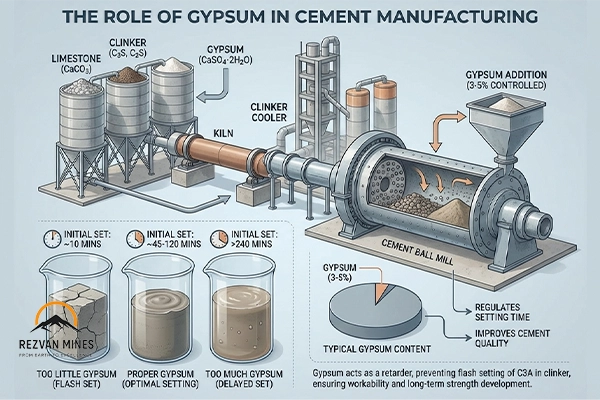
Gypsum in cement manufacturing is used to control cement setting time and prevent flash setting during hydration. By regulating the reaction between clinker and water, gypsum ensures workability, consistency, and predictable performance in both fresh and hardened cement.
Cement manufacturing is a tightly controlled process where even small material variations can significantly affect final performance. Among all additives used in cement production, gypsum plays a uniquely critical role. Without gypsum, cement would set too rapidly, making it unusable for most construction applications.
The primary function of gypsum in cement manufacturing is to regulate setting time. When clinker is ground into cement, it reacts aggressively with water. Gypsum slows this reaction, allowing enough time for mixing, transportation, placement, and finishing. This is why gypsum is not optional—it is a functional necessity in modern cement production.
Beyond setting time control, gypsum also influences cement workability, strength development, and long-term durability. The role of gypsum in cement becomes even more important when production scales increase and consistency across batches is required. Industrial cement plants depend on predictable behavior, and gypsum acts as a stabilizing agent within the system.
Another often overlooked aspect is gypsum quality. Not all gypsum performs equally in cement manufacturing. Factors such as purity, moisture content, and chemical composition directly impact how effectively gypsum controls setting reactions. Using low-quality raw gypsum stone can result in inconsistent cement performance, increased waste, and customer complaints downstream.
Understanding why gypsum is added to cement is not just a technical concern—it is a commercial one. For cement manufacturers, builders, and material suppliers, gypsum selection affects productivity, cost control and product reliability.
This article breaks down gypsum in cement manufacturing from an industrial perspective, covering its role, optimal percentage, and how gypsum quality impacts cement performance. The goal is simple: provide clear, decision-focused insight without unnecessary theory.
What Is the Role of Gypsum in Cement?
The role of gypsum in cement is fundamentally tied to controlling the hydration reaction of clinker minerals, particularly tricalcium aluminate (C₃A). Without gypsum, this reaction occurs too rapidly, leading to what is known as flash setting—a condition where cement stiffens almost immediately after water addition.
In cement manufacturing, clinker alone reacts aggressively with water. This rapid reaction generates heat and causes immediate loss of workability. Gypsum is added to cement specifically to slow down this process. By forming temporary compounds with C₃A, gypsum delays hydration just enough to make cement usable in real-world construction conditions.
How Gypsum Works Inside Cement
When gypsum is introduced during cement grinding, it dissolves partially upon contact with water. Sulfate ions released from gypsum interact with aluminate phases in clinker, creating a controlled chemical barrier. This mechanism prevents uncontrolled reactions and allows cement to remain workable during mixing, transport, and placement.
This is why gypsum in cement production is not considered a filler or minor additive. It is a functional regulator. Even small variations in gypsum dosage or quality can alter cement behavior significantly.
Why Gypsum Is Added to Cement—From an Industrial Perspective
From an industrial standpoint, gypsum serves three core purposes:
- Setting time regulation to prevent flash setting
- Process stability across large production batches
- Consistency in performance for downstream users
This explains why gypsum in cement manufacturing is standardized across global cement plants. Although the exact gypsum percentage in cement may vary slightly depending on clinker composition and regional standards, the functional role remains the same.
Gypsum Is Not Just Gypsum: Quality Matters
A common misconception in the industry is treating all gypsum as interchangeable. In reality, the role of gypsum in cement is highly dependent on its chemical purity and physical properties. Impurities such as clay, excess moisture, or inconsistent particle size can disrupt sulfate availability, leading to unstable setting behavior.
This is where raw gypsum stone quality becomes critical. Cement plants sourcing low-grade gypsum often face issues like uneven setting time, strength variability, and increased quality complaints from contractors and builders.
Operational Impact on Cement Plants
In large-scale cement manufacturing, even minor setting time deviations can cause major operational problems. Delayed or accelerated setting affects grinding efficiency, storage behavior, and customer satisfaction. That is why gypsum selection is treated as a technical decision, not a procurement shortcut.
Understanding the role of gypsum in cement is essential before discussing dosage, quality benchmarks, or sourcing strategy—which is exactly what the next sections will address.
How Gypsum Controls Cement Setting Time
One of the most critical functions of gypsum in cement manufacturing is controlling cement setting time. Setting time determines how long cement remains workable after mixing with water. Without proper control, cement becomes impractical for construction use.
Cement Hydration Without Gypsum: The Core Problem
When cement comes into contact with water, hydration reactions begin immediately. The most reactive component in clinker—tricalcium aluminate (C₃A)—reacts extremely fast. If this reaction is left unmanaged, cement undergoes flash setting, meaning it stiffens within minutes, often before placement or finishing is possible.
This is exactly why gypsum is added to cement. Gypsum acts as a chemical regulator that slows down the hydration of C₃A, preventing uncontrolled reactions and allowing predictable working time.
Effect of Gypsum on Cement Setting Time
The effect of gypsum on cement setting time is both chemical and practical. When gypsum dissolves in water, it releases sulfate ions that temporarily react with aluminate phases. This reaction forms intermediate compounds that delay rapid hydration.
As a result:
- Initial setting time becomes controllable
- Cement remains workable during transport and placement
- Finishing operations can be completed without rush
This controlled behavior is essential in cement manufacturing, especially when production is intended for large-scale construction projects where timing consistency matters.
Cement Setting Time Control: Why Precision Matters
Cement plants do not add gypsum randomly. Cement setting time control gypsum dosage must be carefully calibrated based on clinker composition, fineness, and intended cement application. Even slight deviations in gypsum content can shift setting time outside acceptable standards.
Too little gypsum leads to flash setting.
Too much gypsum delays setting excessively and may negatively affect strength development.
This balance is why gypsum in cement production is treated as a performance-critical component, not a minor additive.
What Happens When Setting Time Is Poorly Controlled?
Poor setting time control has direct consequences across the supply chain:
- Contractors face placement difficulties
- Ready-mix concrete loses consistency
- Structural performance becomes unpredictable
In extreme cases, cement that sets too fast or too slow is rejected entirely by the market. This reinforces why gypsum percentage in cement must be optimized, not minimized for cost savings.
Setting Time Is the Foundation of Cement Performance
Before strength, durability, or long-term performance can even be evaluated, cement must first remain workable. Gypsum enables this by stabilizing early hydration behavior. Without gypsum, modern cement manufacturing at industrial scale would simply not function.
Understanding this mechanism is essential before discussing dosage limits, quality requirements, and sourcing strategies—which is where the next section takes the discussion.
Gypsum Percentage in Cement: How Much Is Used and Why
One of the most common technical questions in cement manufacturing is about dosage: how much gypsum is actually added to cement, and why that specific amount matters. The answer is not arbitrary, but it is also not universal.
Typical Gypsum Percentage in Cement
In most cement plants, the gypsum percentage in cement typically falls within a narrow range. This range is carefully defined to balance setting time control without negatively affecting strength or durability.
Gypsum is added in small proportions relative to clinker, yet its impact is disproportionally large. Even minor changes in gypsum content can shift cement behavior from workable to problematic. This is why cement plants monitor gypsum addition continuously during grinding.
Why Gypsum Dosage Cannot Be Fixed
A critical mistake is assuming that one fixed gypsum percentage works for all cement types. In reality, gypsum dosage depends on several variables:
- Clinker chemical composition
- Aluminate (C₃A) content
- Cement fineness
- Target setting time
- Environmental and application conditions
Because of these variables, gypsum in cement manufacturing is adjusted based on performance testing, not rules of thumb.
What Happens If Gypsum Content Is Too Low?
When gypsum dosage is insufficient, sulfate availability drops. This leads to uncontrolled aluminate hydration and rapid stiffening. In practical terms, cement becomes difficult—or impossible—to use.
Low gypsum levels result in:
- Flash setting
- Poor workability
- High rejection rates at construction sites
This is one of the fastest ways a cement manufacturer can damage product reputation.
What Happens If Gypsum Content Is Too High?
Overcorrecting is just as dangerous. Excess gypsum delays setting too much and may interfere with later hydration stages. In some cases, it can even contribute to long-term durability issues.
From a manufacturing perspective, excessive gypsum means:
- Slower strength development
- Inconsistent performance across batches
- Increased risk of customer complaints
This reinforces why gypsum in cement production must be optimized, not maximized.
Dosage Control Is a Quality Management Issue
The gypsum percentage in cement is not a purchasing decision—it is a quality control parameter. Cement plants that treat gypsum as a low-priority raw material often experience unstable setting behavior and inconsistent product performance.
This is also where gypsum quality becomes inseparable from dosage. Even the correct percentage fails if the gypsum itself is impure or inconsistent. Raw gypsum stone with fluctuating composition forces plants to constantly recalibrate, increasing operational complexity.
Understanding dosage limitations sets the stage for a more critical question: what happens when gypsum is missing entirely or when its quality is ignored—which is exactly what the next section addresses.
What Happens If Cement Is Produced Without Gypsum?
Removing gypsum from cement manufacturing is not a theoretical scenario—it leads to immediate and measurable performance failures. Cement produced without gypsum behaves unpredictably and becomes unsuitable for most construction applications.
Flash Setting: The Immediate Failure
Without gypsum, clinker reacts violently with water. The aluminate phases hydrate almost instantly, causing flash setting. In practical terms, cement stiffens within minutes, often before it can be properly mixed or placed.
This rapid stiffening is not recoverable. Adding extra water does not fix the problem and instead weakens the final structure. This alone makes cement without gypsum commercially unusable.
Loss of Workability and Placement Control
One of the most overlooked consequences of missing gypsum in cement production is total loss of workability control. Contractors rely on predictable setting behavior to manage transport time, placement, and finishing.
Cement produced without gypsum leads to:
- Unmanageable mixing times
- Inconsistent concrete batches
- Increased material waste on site
From a supply-chain perspective, this results in product rejection and reputational damage for manufacturers.
Structural and Performance Consequences
Beyond fresh-state behavior, the absence of gypsum affects hardened cement properties. Uncontrolled early hydration disrupts the formation of stable hydration products, which can negatively impact long-term strength and durability.
Studies on cement hydration chemistry confirm that sulfate regulation is essential for balanced aluminate reactions. Without gypsum, cement systems fail to achieve controlled microstructure development.
Scientific Validation (Single Reference)
The importance of gypsum in regulating cement hydration has been well established in cement chemistry research. A detailed explanation of sulfate–aluminate interactions and their impact on setting behavior can be found in this peer‑reviewed study:
👉 Taylor, H.F.W. – Cement Chemistry
Impact of Gypsum Quality on Cement Performance
A common misconception in cement manufacturing is that adding gypsum alone is enough to control cement behavior. This is wrong. Gypsum quality is as critical as gypsum dosage, and in many cases, it is the deciding factor behind consistent or unstable cement performance.
Why Gypsum Quality Matters More Than Quantity
In gypsum in cement manufacturing, dosage only works when gypsum composition is stable. Gypsum with variable purity or inconsistent mineral phases creates unpredictable hydration reactions, making precise control impossible.
Key quality parameters include:
- Calcium sulfate purity
- Mineral form (dihydrate, hemihydrate, or anhydrite)
- Moisture content
- Level of insoluble impurities
If these factors fluctuate, even a well‑calibrated grinding system cannot compensate.
Influence on Setting Time Stability
Poor‑quality gypsum directly affects setting time consistency. Variations in sulfate availability lead to irregular aluminate reactions, causing unstable setting behavior across production batches.
Operational consequences include:
- Unexpected early setting in some batches
- Delayed setting in others
- Increased customer complaints and site rejections
For cement producers, this inconsistency is a brand risk, not just a technical issue.
Effect on Strength Development
Gypsum quality influences not only early hydration but also long‑term strength development. Impure gypsum can disrupt sulfate balance during hydration, leading to uneven microstructure formation.
Potential outcomes:
- Inconsistent early strength
- Variable final compressive strength
- Reduced reliability in structural applications
For export‑oriented cement producers, this level of uncertainty is unacceptable.
Raw Gypsum Stone as a Supply Chain Variable
Gypsum quality is fundamentally a supply‑chain issue. Cement plants using raw gypsum stone with inconsistent chemical composition must constantly adjust formulations, increasing operational complexity.
This results in:
- Higher quality control costs
- Reduced production efficiency
- Greater risk of non‑compliant cement
In contrast, high‑purity natural gypsum with stable composition allows predictable performance and simpler process control.
Industrial Takeaway
In gypsum in cement production, gypsum quality is not an optional upgrade—it is a performance safeguard. Reliable cement starts with reliable gypsum.
This naturally leads to the next consideration: even with high‑quality gypsum, how does it improve real‑world handling and installation efficiency?
How Gypsum Improves Cement Handling and Installation Efficiency
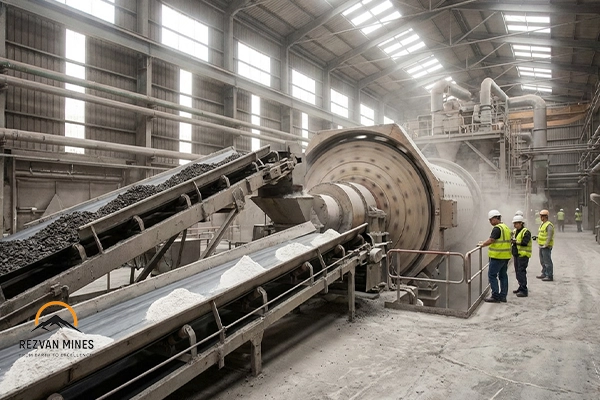
Beyond chemistry and formulation, gypsum plays a decisive role in how cement behaves during handling, transport, and application. This is where theoretical quality translates into real-world efficiency.
Improved Workability During Mixing
Controlled setting behavior allows cement to remain workable during mixing and placement. Gypsum slows down early aluminate reactions just enough to provide a stable working window.
Practical benefits include:
- Uniform mixing consistency
- Reduced risk of premature stiffening
- Better control in batching operations
For large-scale projects, this predictability is not optional—it is operationally critical.
Transportation and Placement Advantages
In commercial construction, cement often travels long distances before use. Without proper setting control, material usability deteriorates rapidly.
By regulating early hydration, gypsum in cement manufacturing enables:
- Longer transport times without quality loss
- Reduced on-site rejection
- More flexible scheduling for contractors
This directly improves supply-chain reliability.
Faster, Cleaner Installation on Site
Well-regulated cement allows smoother placement, easier finishing, and cleaner execution. Crews spend less time correcting material behavior and more time completing work.
From an installation perspective, this means:
- Lower labor costs
- Fewer application defects
- Higher overall productivity
These advantages compound at scale, especially in infrastructure and industrial projects.
Why This Matters for Industrial Buyers
For B2B buyers, efficiency is money. Cement that behaves consistently reduces downtime, minimizes waste, and protects project timelines.
This is why gypsum in cement production is not just a technical additive—it is a performance enabler that directly affects total project cost.
The next logical question is durability: does gypsum only help during installation, or does it influence long-term performance as well? That’s where the next section goes.
Role of Gypsum in Cement Durability and Fire Resistance
Gypsum is often discussed only in the context of setting time, but this is a narrow view. In reality, gypsum also influences long‑term durability and fire performance of cement-based materials—especially in regulated construction environments.
Contribution to Long-Term Durability
Proper sulfate regulation during early hydration helps form a stable and uniform cement matrix. This directly affects how cement performs over time under mechanical and environmental stress.
When gypsum quality and dosage are controlled:
- Hydration products develop more evenly
- Internal stresses are reduced
- Risk of microcracking decreases
This stability improves resistance to shrinkage-related damage and enhances overall durability in structural applications.
Resistance to Thermal Stress
Cement systems exposed to high temperatures experience internal stress due to dehydration and phase changes. Gypsum contributes indirectly by promoting a more controlled hydration structure, which reacts more predictably under thermal load.
In practical terms, cement produced with properly regulated gypsum:
- Maintains structural integrity longer under heat exposure
- Shows reduced risk of sudden failure
- Performs more reliably in fire-prone environments
This is particularly relevant in industrial buildings, tunnels, and high-density urban construction.
Fire Performance in Cement-Based Systems
While gypsum itself is not a fireproofing agent in cement, its role in hydration control improves how cement-based materials respond during fire exposure. Stable microstructure delays heat-induced degradation compared to poorly regulated systems.
This explains why gypsum in cement manufacturing remains standard practice even in regions with strict fire safety regulations.
Why This Matters for Industrial and Export Markets
Durability and fire resistance are not marketing claims—they are compliance requirements. Cement that fails under long-term stress or thermal exposure is quickly eliminated from competitive markets.
For export-oriented producers, gypsum in cement production is part of meeting international performance expectations, not just local standards.
This leads to the final comparison: how gypsum and cement differ in function, application, and value within construction systems.
Common Mistakes Cement Manufacturers Make with Gypsum
Many cement manufacturers underestimate gypsum, treating it as a secondary or low-risk input. This assumption is one of the most common and costly mistakes in cement production.
1. Assuming All Gypsum Is the Same
Gypsum varies significantly in:
- Purity (CaSO₄·2H₂O content)
- Moisture level
- Particle size distribution
- Presence of impurities (clay, limestone, organic matter)
Ignoring these differences leads to unstable setting behavior and inconsistent cement quality.
2. Overlooking Quality Consistency
Even acceptable gypsum chemistry is useless if consistency is poor. Fluctuations between shipments create:
- Unpredictable setting times
- Grinding instability
- Increased quality control interventions
In gypsum in cement manufacturing, consistency matters as much as chemical composition.
3. Poor Supply Chain Control
Relying on spot suppliers or unverified sources increases risk:
- Irregular delivery volumes
- Inconsistent quality batches
- Lack of traceability
Cement production depends on continuity. Gypsum supply must match that requirement.
4. Focusing on Price Instead of Performance
Low-cost gypsum often hides indirect costs:
- Higher rejection rates
- Production slowdowns
- Customer complaints
This short-term mindset damages long-term competitiveness, especially in export markets.
Buyer’s Perspective: How to Source the Right Gypsum for Cement Manufacturing
From a buyer’s standpoint, sourcing gypsum is not a procurement task—it is a performance decision.
Evaluation Checklist for Cement Producers
Before finalizing a gypsum supplier, buyers should verify:
- Chemical purity and sulfate content
- Moisture stability across seasons
- Particle size suitability for grinding systems
- Long-term supply capacity
- Export and logistics readiness
This checklist reduces operational risk and improves cement consistency.
Importance of Supplier Transparency
Reliable suppliers provide:
- Clear technical specifications
- Batch consistency documentation
- Predictable delivery schedules
Lack of transparency usually signals lack of control.
Strategic Sourcing Advantage
Manufacturers who treat gypsum sourcing as a strategic input benefit from:
- Stable production planning
- Reduced quality fluctuations
- Stronger customer trust
In competitive markets, these advantages directly impact profitability.
Final Thoughts: Why Gypsum Quality Matters More Than Price
In cement production, gypsum is small in percentage—but massive in impact.
Poor gypsum quality compromises:
- Setting control
- Durability
- Fire performance
- Market reputation
High-quality gypsum, by contrast, stabilizes the entire production chain.
BOFU Takeaway for Decision Makers
If cement quality matters, gypsum quality cannot be negotiable. The real cost is not the price per ton—it is the performance per ton.
This is the core reality of gypsum in cement manufacturing.
For cement manufacturers seeking reliable setting control and export-grade consistency, sourcing high-quality raw gypsum stone is a strategic necessity—not a cost-saving experiment.
👉 Discover industrial-grade Raw Gypsum Stone from Rezvan Mines
- Controlled purity
- Consistent supply
- Cement-industry focused production