Rezvan Mines Blog

The Rezvan Mines Blog delivers expert insights, industry updates, and practical knowledge on gypsum products and modern construction solutions. The Rezvan Mines Blog supports professionals and international partners with reliable information for informed material selection and successful project outcomes.

Gypsum plaster setting time is the period during which the mix hydrates and hardens, measured in two stages. Initial set is when the mix stops being workable and can no longer be placed. Final set is when it resists penetration. Declared figures are laboratory values, tested at 23 °C and 50 % relative humidity.
Wall putty is a thin surface preparation layer that fills minor imperfections before painting. It comes in four binder types: white cement-based, gypsum-based, acrylic ready-mixed, and polymer-modified. Cement-based and polymer-modified products suit both interior and exterior walls, while gypsum-based and acrylic products are for interior use only.
Gypsum plaster can be used in a bathroom, but only on the right surfaces. It is suitable for ceilings and walls away from direct water in a ventilated room. It is not suitable for splash areas or inside a shower, because set gypsum is soluble and loses strength when repeatedly wetted.
Gypsum plaster vs gypsum board is a system choice, not a product choice. Gypsum plaster is the wet system: trowelled onto masonry or concrete for a monolithic, jointless surface. Gypsum board is the dry system: fixed to a frame or bonded to masonry, and ready for jointing within hours.
Agricultural gypsum is calcium sulphate dihydrate, a soil amendment that supplies calcium and sulphate-sulphur to soil. It does not change soil pH. Growers use it to reclaim sodic soils, correct calcium or sulphur deficiency, and improve infiltration where clay has dispersed. Rates depend on a current soil analysis.
Gypsum falls under HS heading 2520. Uncalcined gypsum and anhydrite are classified at 2520.10, while calcined gypsum plasters are classified at 2520.20. The split is calcination, not particle size. Additive-rich products such as putty powder or joint filler may instead fall under heading 3214, depending on composition and intended use.
For industrial buyers, gypsum rock export specifications are the single most important filter separating a profitable shipment from a rejected container. These specifications govern chemical purity, physical grading, and contamination thresholds. Getting them wrong means production losses downstream.
What follows is the mechanism behind every quotation you receive. It includes a worksheet that makes three offers comparable, and what to send us for a real figure.
Use the gypsum plaster calculator below to get your number now. The plaster coverage calculator takes the area, the coating thickness, and the plaster type, and returns kilograms, bags, pallets and container loads. The guide underneath explains where the number comes from and which six factors push it up. It also covers how much wastage to allow before ordering.
They are the same mineral. Plaster of Paris — POP, as most sites call it — and gypsum plaster are both calcined gypsum. The difference is how they were heated during production. That single difference changes setting speed, strength, and where each one belongs.
This guide is a checklist you can run against a real document. It covers what a specification tells you and what it hides. It sets out the chemical and physical parameters that decide quality, which standard to ask for, and how to verify a supplier. Knowing how to read a gypsum technical data sheet is the difference between buying material and buying a promise.
This guide compares the three families a buyer will be offered. It sets out what changes in processing, and what to write into a purchase specification. It answers the question behind the natural vs synthetic gypsum debate: is synthetic gypsum as good as natural gypsum, and under what conditions? The short answer is that a well-run scrubber competes with any mined source. But the risks attached to each route differ, and so does their durability.
Industrial uses of micronized gypsum span multiple sectors due to its unique combination of particle fineness, chemical inertness and cost-effectiveness. Micronization reduces calcium sulfate dihydrate (CaSO₄·2H₂O) to ultrafine particles—typically 325 mesh (44 microns) or finer—transforming raw gypsum into a high-performance industrial mineral. This particle size reduction dramatically increases surface area, improving reactivity, dispersion uniformity and compatibility with diverse manufacturing processes.
For importers sourcing mineral inputs at scale, bulk gypsum logistics is rarely the headline concern, yet it quietly determines profitability. The gap between a competitive FOB price and a punishing landed cost almost always sits in transport, packaging, and loss. This guide treats logistics as a procurement lever, not an afterthought.
There is nothing more frustrating for a homeowner or a contractor than walking into a newly finished room and spotting a jagged line running across the wall. It ruins the aesthetic, creates anxiety about the building’s safety, and often leads to disputes between clients and builders. While some cracks are inevitable due to the natural settling of a building, many are entirely preventable.
When comparing Satin Gypsum vs Putty Powder, the primary difference lies in their composition and finish. Satin Gypsum is a polymer-modified, micronized plaster that creates a hard, non-absorbent, and glass-smooth surface requiring minimal sanding. In contrast, traditional Putty Powder (often oil or acrylic-based mastic) is softer, highly absorbent, and shrinks upon drying, necessitating multiple layers and extensive sanding to achieve a flat surface. For high-end finishes and paint savings, Satin Gypsum is the superior choice.
The structural integrity of a building lies in its foundation and masonry, but its aesthetic value and perceived quality depend entirely on the final visible surface. In the realm of Interior wall finishing, the margin for error is zero. The base coat of plaster (browning or rendering) is designed to level the masonry and provide a flat substrate, but it is inherently rough, porous, and completely unsuitable for direct decoration.
In modern construction, the shift from brick masonry to reinforced concrete structures has revolutionized building stability, but it has introduced a significant challenge for interior finishing: plastering smooth concrete. Unlike traditional brick or block walls, which offer a rough, high-suction surface perfect for standard gypsum adhesion, modern concrete elements—such as pillars, ceilings, and shear walls—are often dense, non-absorbent, and incredibly smooth.
Gypsum in cement manufacturing is used to control cement setting time and prevent flash setting during hydration. By regulating the reaction between clinker and water, gypsum ensures workability, consistency, and predictable performance in both fresh and hardened cement.
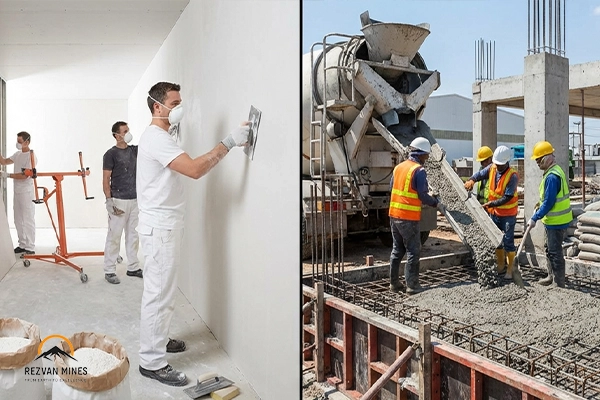
The comparison of Gypsum vs Cement goes far beyond appearance or cost and directly affects construction speed, durability, fire performance, and long-term maintenance.
In this guide, we compare fire resistant gypsum vs regular gypsum by focusing on performance, fire behavior, applications, and cost implications, helping you determine which option is appropriate for your specific construction project.
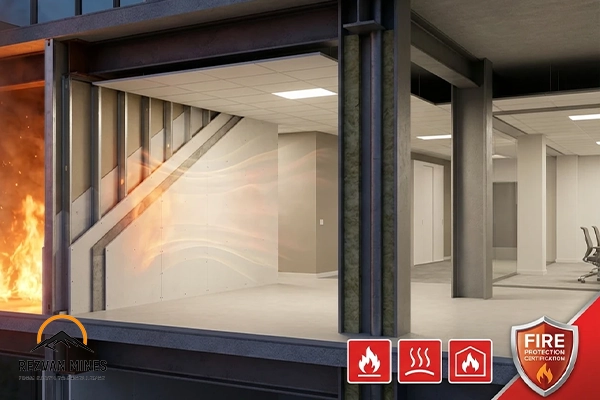
Fire Resistant Gypsum Plaster is a gypsum-based construction material designed to resist fire exposure by slowing heat transfer, maintaining structural integrity, and contributing to passive fire protection in buildings. It contains chemically bound water that helps delay temperature rise during a fire.
The right gypsum product depends on several critical factors, including the application type, required surface quality, fire resistance, setting time, and long-term durability. To choose the right gypsum product, builders must evaluate whether the gypsum will be used for wall finishing, ceiling applications, decorative elements, or fire-resistant systems, while also considering compatibility with interior wall finishing materials and construction standards.

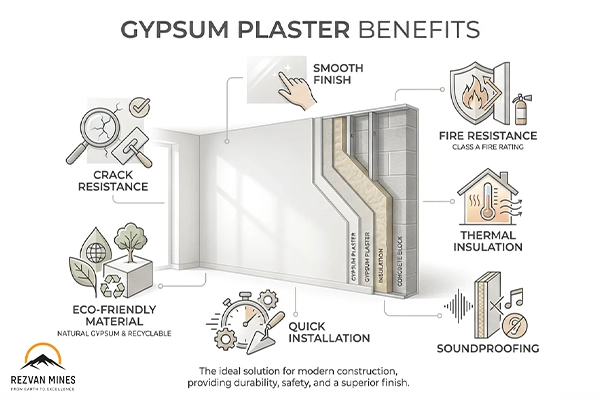
Gypsum plaster offers numerous benefits in modern construction, including smooth surface finishing, fast setting time, fire resistance, lightweight structure, and eco‑friendly properties. It is widely used for interior walls and ceilings due to its durability, aesthetic quality, and cost‑effective application compared to traditional cement plaster.