
Most growers who buy gypsum expect it to sweeten acid ground the way lime does. It cannot. Gypsum supplies calcium and sulphate to the soil, and no change in pH can be expected from a gypsum application.
That sentence separates honest agronomy from most of what is written about gypsum for soil. Does gypsum raise soil pH? No — and any supplier who says otherwise has not understood the product.
What agricultural gypsum genuinely does is narrower, and more useful, than the marketing suggests. It supplies two nutrients, displaces sodium on sodic ground, and can improve infiltration and surface structure under specific conditions.
It does nothing at all for a soil that has none of those problems, which is why the soil test comes before the order. This guide sets out where gypsum works, where it is wasted money, and what to specify when buying.
What Agricultural Gypsum Actually Does
Chemically, ag gypsum is calcium sulphate dihydrate. It dissolves in soil water and releases two ions: calcium and sulphate. Everything gypsum does on a farm follows from those two ions and one physical property: moderate solubility. It dissolves far more readily than lime, which is why it moves down the profile, but it is not highly soluble. That matters more than most buyers realise.
Because it releases calcium without a carbonate, hydroxide or oxide attached, gypsum cannot neutralise soil acidity. Lime supplies calcium with a carbonate that reacts with hydrogen ions in the soil solution. Gypsum’s sulphate does no such thing. The calcium arrives, the pH stays where it was.
That calcium can take the place of another cation on the soil’s exchange complex — the clay and organic fractions that hold and swap nutrient ions. On sodic ground it displaces sodium; on acid subsoils, aluminium. Neither reaction changes pH. Both change what sits on the exchange sites, and that is the mechanism behind most legitimate uses of this calcium sulphate soil amendment.
One term worth defining early: US growers, particularly in groundnut country, call this material land plaster. It is the same product under an older trade name.
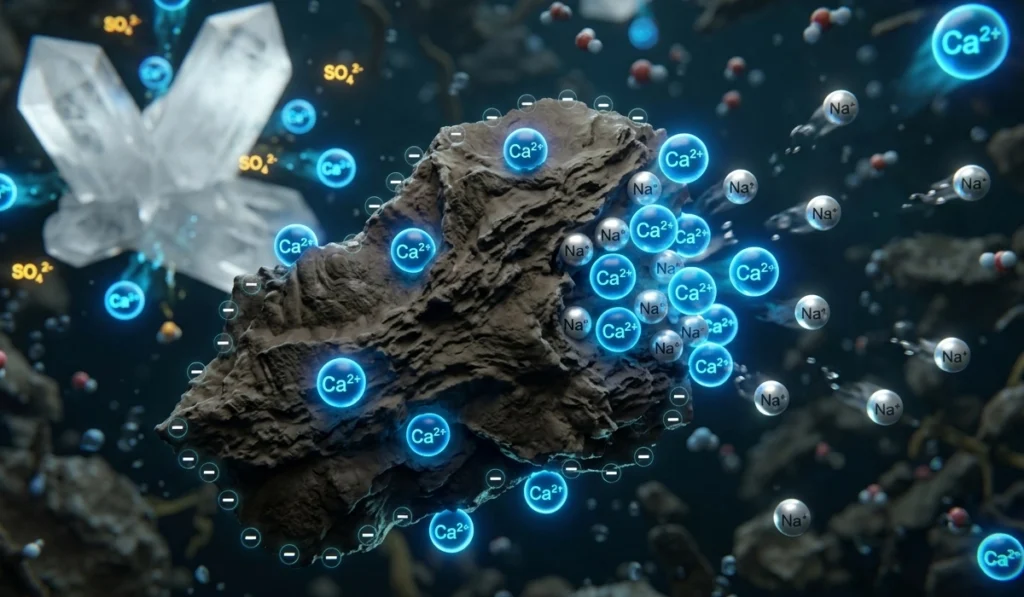
Calcium and sulphate, without changing pH
Both ions gypsum releases are genuinely useful in crop nutrition. Calcium is an essential nutrient and a structural component of cell walls. Sulphate-sulphur is the form plant roots actually absorb, so gypsum’s sulphur is available without waiting for any conversion in the soil.
Is gypsum a fertiliser? Partly, and the honest answer matters commercially. It supplies two nutrients, so in that narrow sense it feeds a crop. But it carries no nitrogen, no phosphorus and no potassium, and it is normally classified and sold as a soil amendment rather than a fertiliser. Treating it as a substitute for a compound fertiliser is a mistake. Treating it as a calcium and sulphur source, alongside your normal programme, is correct.
Why gypsum is not a liming material
The gypsum vs lime for soil question is the most consequential one in this subject, and it has a clean answer. What is the difference between gypsum and lime for soil? Lime corrects acidity. Gypsum does not. They are not interchangeable, and substituting one for the other wastes a season.
Use lime where the measured problem is low pH. Use gypsum where the measured problem is exchangeable sodium, a calcium requirement, or a sulphur requirement. Apply gypsum to an acidity problem and you will have added two nutrients and corrected nothing. This is the most common disappointment we hear about: a grower applies gypsum expecting a pH change, retests, and finds the pH exactly where it started. No pH change was ever possible. The product did what it was chemically capable of doing.
The Five Jobs Gypsum Does on a Farm
Gypsum earns its place in five specific situations. Each depends on a measured soil condition, not a general belief that the ground needs improving. Read these as a checklist: if your soil matches none, this gypsum soil amendment will do little for you, whatever the bag says.
Only one of the five is the use most buyers have heard of: sodic reclamation. It is also the one the USDA gypsum standard explicitly hands to a different standard.
1. Sodic soil reclamation
This is gypsum’s strongest and best-documented use. Can gypsum fix sodic soil? Yes, under conditions. Sodic ground carries excess sodium on the exchange complex, which disperses clay and destroys structure. Calcium from gypsum for sodic soil replaces that sodium. But displacement is only half the job — the freed sodium must then leach below the root zone, which requires water and functioning drainage. NRCS directs sodic remediation to CPS 610, not to the gypsum standard, precisely because drainage and leaching govern the outcome.
2. Sulphur nutrition
Gypsum is a legitimate sulphur source for crops, and its form is the advantage. Sulphate-sulphur is the only form plant roots take up. Elemental sulphur must first be oxidised by soil microbes into sulphate, a conversion that takes time and slows in cool soils. Gypsum skips that step entirely. The trade-off is mobility: sulphate leaches, particularly on coarse-textured ground under heavy rainfall or irrigation, so timing matters more than it would with elemental sulphur.
3. Calcium nutrition
Some crops need calcium delivered to a specific place at a specific time. Groundnut is the clearest case. The developing pod absorbs calcium directly from the soil around it, not through the plant, so calcium must be present in soluble form in the pegging zone during pod fill. Foliar calcium cannot substitute. Calcium-related disorders in horticultural crops follow similar logic. Blossom-end rot in tomato and pepper is one example: the calcium must reach the tissue, in water, at the right growth stage.
4. Infiltration, crusting and aggregate stability
Where sodium or excess magnesium has dispersed the clay fraction, calcium promotes flocculation — particles bind into stable aggregates instead of separating. Better aggregate stability means less soil crusting after rain, easier seedling emergence, and a higher infiltration rate. This is where soil conditioner gypsum is a fair description. Does gypsum help compacted or clay soil? Only when dispersion is the cause. Gypsum for clay soil corrects a chemical problem, not a physical one. Compaction from machinery traffic is physical, and no amendment corrects it. Extension trials on non-dispersed soils measured no change in penetration resistance.
5. Subsoil aluminium and phosphorus runoff
Two further uses appear in the USDA standard. In acid subsoils, soluble aluminium is toxic to root tips, and roots stop descending. Lime cannot easily reach that depth; gypsum, being more soluble, can move down and displace aluminium from the exchange sites, reducing aluminium toxicity and allowing deeper rooting. Separately, surface-applied gypsum can reduce dissolved reactive phosphorus — the readily available phosphorus fraction most prone to loss — in runoff and drainage, by lowering phosphorus solubility in high-phosphorus soils.
How Rates Are Actually Decided
This section will disappoint anyone looking for a number, and that is deliberate. There is no universal gypsum application rate for agriculture, because the correct rate depends on the soil, the purpose, the crop and the country. Anyone who quotes a figure without seeing a soil analysis is guessing with your season.
Start with a soil test. Not as a formality — as the actual input to the calculation. The USDA standard requires a soil analysis no older than one year before a rate is planned. It must report cation exchange capacity (CEC, the soil’s capacity to hold exchangeable cations), calcium, magnesium, pH and phosphorus.
Sodic ground uses a different measure. CPS 610 bases the amendment requirement on the sodium adsorption ratio (SAR) of the soil water extract, or on exchangeable sodium percentage (ESP) where the laboratory reports it. Amendment purity and irrigation water quality both feed into the same calculation.
What the US standard states, scoped to the US: CPS 333 sets a ceiling of five tons per acre annually for the purposes defined in that standard. It prescribes minimum rates on the basis of 100 percent calcium sulphate dihydrate equivalency, so a product testing below that must be adjusted upward. Those are provisions of a United States conservation standard. They are not recommendations for India, the Gulf, Africa or the EU.
Then the point that matters most: NRCS states plainly that its national conservation practice standards should not be used to plan, design or install a practice. That is what the local Field Office Technical Guide and a local agronomist are for. The same logic applies anywhere. Only a local adviser looking at your analysis can turn a standard into a field plan.
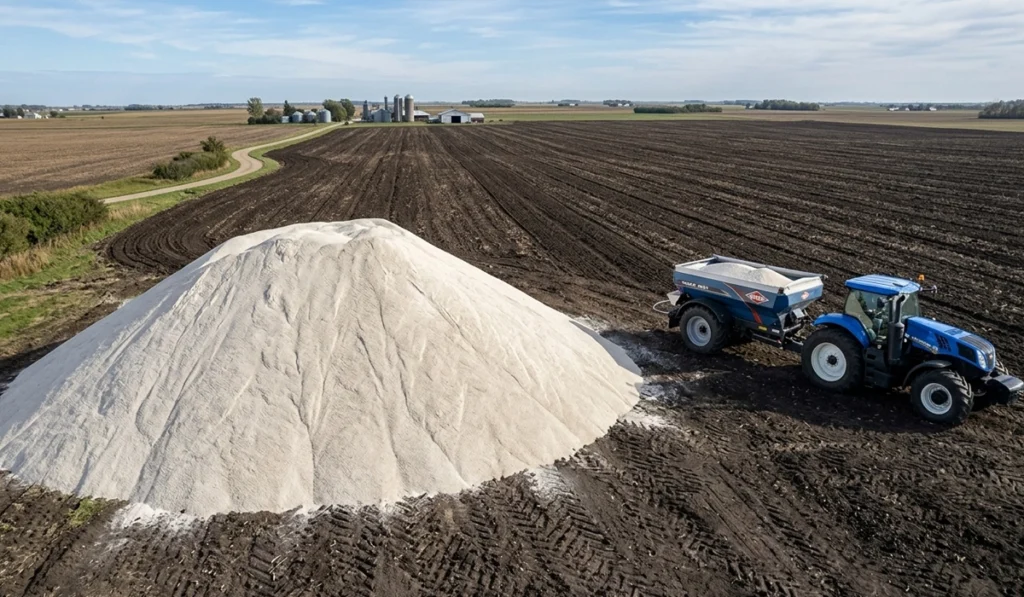
Product Quality: What to Look For
Distributors and importers ask a different question from farmers: what separates a saleable product from a problem. The USDA standard is unusually explicit here, and worth reading even outside the US, because it gives buyers a defensible specification to quote.
Two provisions do most of the work. First, particle size: gypsum-containing products must be smaller than 1/8 inch, roughly 3 mm. What is the best particle size for agricultural gypsum? Fine enough to dissolve at a useful rate and to pass the standard, coarse enough to flow through a broadcast spreader and not blow away on application day. Second, and commercially the more important: the amendment provider is responsible for furnishing chemical analysis documentation. That analysis must cover calcium and sulphur content, plus the heavy metals and other contaminants listed in the standard. The standard also caps radium-226 at 10 picocuries per gram.
| Parameter | Why it matters | What to ask for |
| Calcium sulphate dihydrate content | Sets the effective rate; standards express minimum rates at 100% equivalency | Declared percentage on a test report |
| Particle size | Governs dissolution speed and spreader compatibility | Grading curve; the USDA standard requires under 1/8 inch |
| Free moisture | Affects flow through a spreader and caking in storage | Declared maximum |
| Calcium and sulphur content | The two nutrients actually being supplied | On the chemical analysis, per the standard |
| Heavy metals and contaminants | The standard makes this the provider’s responsibility | Full analysis against the standard’s screening list |
| Source (natural / FGD / phosphogypsum) | Determines regulatory acceptability in some countries | Stated origin, with documentation |
| Form (crushed, screened, granulated) | Determines application method | Match to the customer’s spreader |
| Batch traceability | Required if a problem needs investigating | Lot number on the analysis |
Two rows cause most of the practical trouble. Free moisture is the quiet one: a material within specification on chemistry can still cake in the bag or bridge in the hopper if it ships wet. Declare a maximum and hold the supplier to it. Form is the other — crushed and screened material and granules behave differently in the same machine.
A distributor who cannot answer a buyer’s heavy-metal question loses the order. That is the most common way a gypsum enquiry dies. The analysis is not paperwork for its own sake. Under the standard it is the supplier’s obligation, and it is what lets a buyer defend the purchase to their own agronomist or certifier.
Where Gypsum Is the Wrong Answer
Six failures account for most disappointed buyers. Each has a root cause and a decision that prevents it.
No pH change. Root cause: gypsum is not a liming material. Prevented by using lime for acidity, and reserving gypsum for calcium, sulphur and sodicity.
Sodic ground does not improve. Root cause: no drainage, so displaced sodium has nowhere to go. Calcium knocks sodium off the exchange sites, but without leaching it simply redistributes. FAO is explicit that leaching only works where drainage carries salts out of the reclamation area. Confirm drainage before ordering.
No visible response. Root cause: the soil had no calcium, sulphur or sodium problem to begin with. Extension trials on such soils report positive yield responses are rare. Soil test first.
Will not flow through the spreader. Root cause: wrong particle size, or free moisture causing caking. Specify grading and maximum moisture at the order stage.
Judged too early. Root cause: low solubility. How long does agricultural gypsum take to work? Longer than one season. It needs water and time to dissolve and move, so assess over seasons.
Refused by a regulator. Root cause: the source is not permitted for agricultural use in that market. Confirm the source and the destination country’s rules before shipping.
Two further US restrictions matter. Do not apply gypsum where sulphate additions are restricted in the watershed. On pasture, apply when livestock are absent, and keep them out until rain or irrigation has washed it off the vegetation.
Natural, FGD or Phosphogypsum for Farmland?
Three sources reach the market, and for farmland they are not equivalent. The full comparison belongs elsewhere — see how natural, FGD and phosphogypsum compare — but their agricultural acceptability differs sharply, and that is a buying decision.
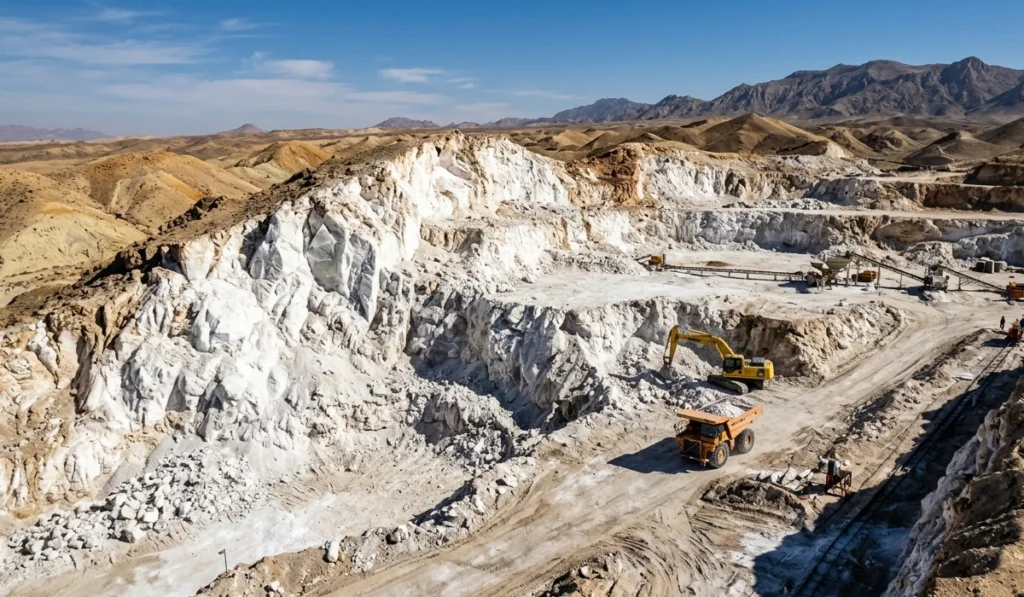
Natural mined gypsum is quarried rock, crushed and screened. Its composition reflects the deposit, so a deposit-specific analysis matters.
FGD gypsum is a by-product of flue gas desulfurisation at coal-fired power stations. Can you use FGD gypsum on farmland? In the US, yes, within limits. The USDA standard accepts FGD gypsum produced by forced-oxidation wet systems after fly ash has been removed. The same contaminant screening applies as to any other source.
Phosphogypsum is the most restricted. It is a by-product of phosphoric acid manufacture, and because phosphate rock contains uranium and radium, the residue concentrates those radionuclides. US EPA rules require phosphogypsum to be managed in engineered stacks. A narrow exception permits removal for outdoor agricultural use, but only where the certified average radium-226 concentration does not exceed 10 picocuries per gram. Other uses need advance EPA approval. Rules vary by country — check yours before specifying it.
Buying Agricultural Gypsum: What to Specify
The USDA standard makes the supplier responsible for providing a chemical analysis covering calcium, sulphur and heavy metals. Ask any agricultural gypsum supplier for it. If they cannot produce one, you are buying an unknown material and carrying the risk yourself.
Specify six things on the enquiry and most quality problems disappear before they start. Ask for calcium sulphate dihydrate percentage, grading curve and maximum particle size, and maximum free moisture. Then ask for declared calcium and sulphur content, a full contaminant analysis against a named screening list, and the stated source with documentation. Add lot numbers if you may need to investigate a complaint. Confirm the form too — crushed and screened, or gypsum granules — since that decides whether a broadcast spreader can apply it.
Rezvan Mines works a natural deposit in the Semnan region and has processed gypsum for over 40 years, with third-party analysis through SGS and Intertek. That matters for one reason: it is exactly the documentation the standard makes the provider responsible for furnishing. See our deposit and production facilities, raw gypsum stone from our own deposit, how to read the analysis behind these numbers, and classification and import paperwork. To move forward, request a sample and full analysis.
Conclusion
Gypsum supplies calcium and sulphate and changes no soil’s pH. Everything else follows from that. Use gypsum where the measured problem is exchangeable sodium, a calcium requirement, or a sulphur requirement — and where drainage exists to carry displaced sodium away. Use lime where the measured problem is acidity. They are not substitutes for one another, and no amendment corrects machinery compaction.
Two decisions are now yours. First, test the soil before ordering, because the parameters that decide the answer — ESP or SAR, CEC, pH, sulphur status and drainage — are all measurable. Second, take any rate from a local agronomist working to your own country’s guidance. When you know what you need, request a sample and full analysis.
FAQ
Does gypsum raise soil pH?
No. Gypsum supplies calcium and sulphate but cannot neutralise acidity, because the calcium arrives without a carbonate, hydroxide or oxide. Use a liming material if acidity is the measured problem.
Is gypsum the same as lime?
No. Lime is calcium carbonate and corrects acidity. Gypsum is calcium sulphate and does not. Both supply calcium, but only lime raises pH. Choose between them on what your soil analysis shows.
Will gypsum break up clay soil?
Only where sodium or excess magnesium has dispersed the clay. On non-dispersed clay, and on soil compacted by machinery traffic, gypsum makes little difference. A soil test showing sodicity justifies the application.
Is gypsum a fertiliser?
It supplies two plant nutrients, calcium and sulphur, so it feeds a crop in a limited sense. It carries no nitrogen, phosphorus or potassium, and is normally classified as a soil amendment.
How much gypsum should I apply?
There is no general answer. Rates depend on soil, purpose, crop and country. The USDA standard requires a soil analysis under one year old, covering CEC, calcium, magnesium, pH and phosphorus.
What is the difference between saline and sodic soil?
Salinity means total soluble salts, measured as electrical conductivity (EC). Sodicity means excess sodium on the exchange complex, measured as ESP or SAR. Handbook 60 treats ESP 15 as the boundary. Gypsum addresses sodicity.
Can I use FGD gypsum on my land?
In the US, the standard accepts FGD gypsum from forced-oxidation wet systems after fly ash removal, subject to contaminant screening. Elsewhere rules vary, so confirm your own country’s position first.
Why has my gypsum done nothing after one season?
Low solubility. Gypsum needs water and time to dissolve and move through the profile, and structural change is often invisible after one application. The soil may also have had no problem to correct.