
Ask ten specifiers about gypsum plaster vs gypsum board, and most will answer as if it’s a drywall vs plaster contest between two brands of one product. They are not.
Gypsum plaster is the wet system. Gypsum board is the dry system, also called drywall, plasterboard, or gypsum panel. Each solves a different construction problem, in a different kind of building, with a different trade.
This guide treats them as what they are: two distinct building systems, each with a proper place.
Is drywall better than plaster? That question has no single answer. The honest one depends on your building, your market, and your programme. We supply the materials for both systems, so we have no commercial reason to favour one build-up over the other.
What follows is a practical comparison of substrate needs, speed, services, finish quality, and failure points, so you can match the system to the project.
Two Systems, Not Two Products
Gypsum plaster vs gypsum board is really a question about two construction systems, not two products from one catalogue. The wet system means gypsum plaster, also called solid plaster or wet plaster. It is trowelled directly onto a solid background, such as masonry, block, or concrete. The dry system means gypsum board. It is known as drywall in the US, plasterboard in the UK and India, and gypsum board across the Gulf and international markets. It is fixed to a frame, or bonded to masonry. In UK usage, board fixed straight onto a masonry wall has its own name, described in the next section. Some markets simply call the whole dry approach a drywall system.
The difference between dry lining and plastering comes down to what happens to the wall while it’s being built. Plastering adds a wet material that must dry out before decoration. A manufactured board needs no drying-out period; it’s ready for jointing within hours. Neither approach is more advanced in interior construction — they answer different questions. A solid background invites the wet system. A framed cavity, or a masonry wall that needs services buried behind it, invites the dry system.
Architects, contractors, and developers all ask the same question when they weigh wet system vs dry system as building systems. Which build-up suits this building, this pool of skilled labour, and this programme? The sections below answer that with factors, not a verdict, because the honest answer changes by project.
The wet system: plaster on a solid background
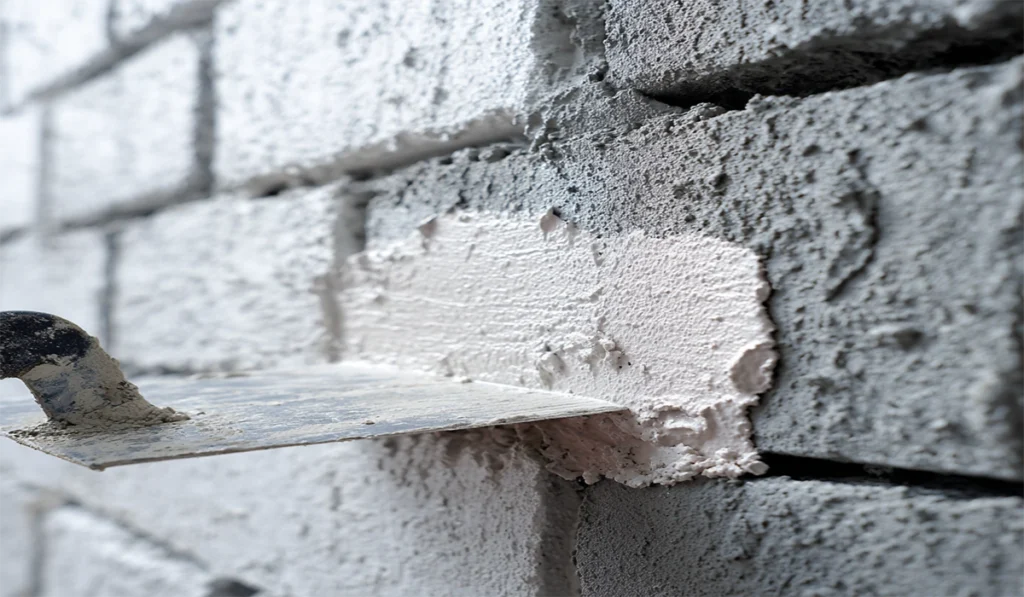
The wet system starts with a solid background: masonry, block, or monolithic concrete, prepared to receive solid plaster. ASTM C842 sets the minimum requirements for full-thickness interior gypsum plaster on gypsum, metal, masonry, or concrete bases. In practice, a plasterer floats a monolithic coat directly onto the wall, with no joints and no boards. Finishing plaster, sometimes sold as satin gypsum or micronized gypsum, gives the smooth final surface ready for decoration. On low-absorption backgrounds, such as dense concrete or smooth block, Gyptone gypsum for low-absorption backgrounds bonds where an ordinary plaster would struggle. The result is a continuous surface, with no fasteners and no visible joints, provided the background is sound and true.
The dry system: boards on a frame, or bonded to masonry
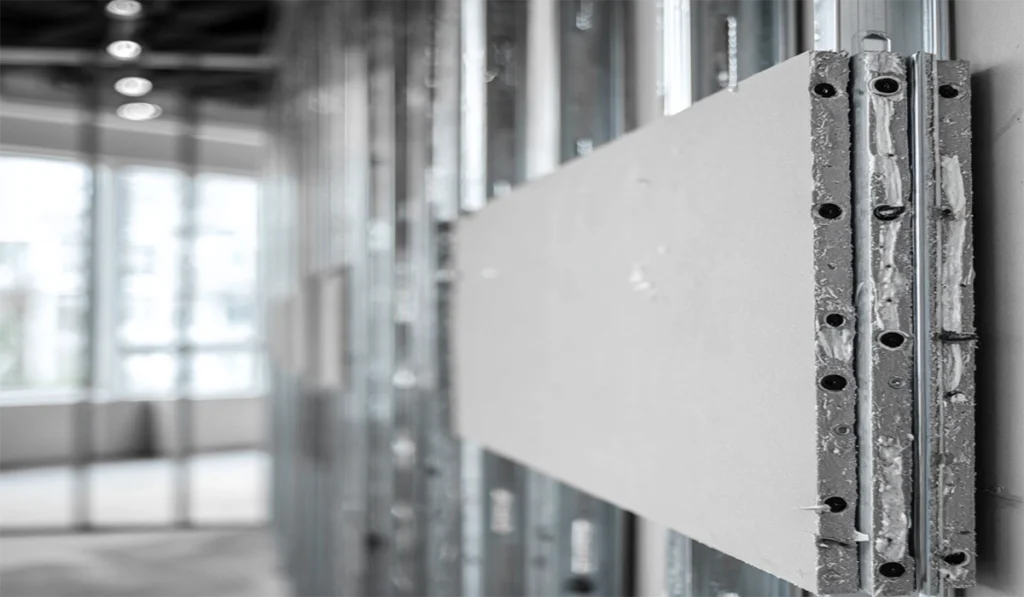
The dry system builds a wall from manufactured board, not wet material. ASTM C1396/C1396M defines the gypsum boards used for this: wallboard, backing board, and related products, each designed for a specific position in the assembly. Two fixing methods dominate. On a metal or timber stud frame, board is screwed to the studs, leaving a service void behind it. On solid masonry, board can instead be bonded directly to the wall with adhesive dabs. This method, sometimes called dot and dab, corrects an out-of-plumb background without a full stud frame. Joint filler powder and jointing compound then tape and fill the joints. Boards are dimensionally stable on delivery, so jointing starts almost immediately.
How They Actually Compare
Set plasterboard vs wet plaster side by side, and the pattern is not “better” and “worse”. It’s “suited” and “unsuited”. The table below draws on ten factors that architects and contractors actually weigh on site, from what background each system needs to how forgiving each is of later movement. Fire and acoustic performance are deliberately assembly-dependent lines, not material claims. Neither gypsum plaster nor gypsum board carries a rating on its own; only a tested wall build-up does. See our note on fire performance in gypsum systems for that detail.
| Factor | Wet system (gypsum plaster) | Dry system (gypsum board) |
| Needs | A solid background — masonry, block, concrete | A frame, or adhesive bonding to masonry |
| Surface | Monolithic, no joints | Jointed; joints taped and filled |
| Speed on site | Slower; needs drying time | Faster to erect; jointing adds time |
| Moisture added to the building | Significant; must dry before decoration | Minimal |
| Services and insulation | Chased into the substrate | Housed in the cavity |
| Fixings for heavy items | Standard plugs into the background | Cavity fixings or noggings required |
| Impact resistance | Generally higher on a solid background | Depends on board type and framing |
| Flatness | Follows the substrate unless dubbed out | Flat plane regardless of substrate |
| Repairs | Skilled patching; can be hard to match | Damaged sections cut out and replaced |
| Movement tolerance | Lower; cracks show at movement | Higher; frame accommodates movement |
| Acoustic and fire | Assembly-dependent | Assembly-dependent |
| Skill required | Skilled wet trade | More systematised, easier to standardise |
Two things stand out. First, the dry system wins on programme speed and moisture control, because it adds little water and can be jointed almost immediately. Second, the wet system wins on monolithic strength and impact resistance on a solid background, because there are no joints to crack and no cavity to punch through.
Read the flatness row carefully, because it decides more renovations than any other line. A plastered wall follows whatever is behind it, so an out-of-plumb background stays out of plumb unless the plasterer dubs it out first. A boarded wall creates its own flat plane. On a refurbishment with a bowed masonry wall, that property often settles the choice on its own.
The movement row matters just as much on new build. A frame flexes and absorbs small structural movement; a monolithic plaster coat shows it as a crack. Neither line is an overall verdict. A fast dry system is no use where there is no frame or masonry ready for it. A strong monolithic wall is no use where services must be buried in a cavity. A gypsum board partition and a plastered masonry wall can sit in the same building. Both can be correct, provided each is specified for what it’s actually being asked to do.
Why the Answer Flips with Labour Cost
Gypsum plaster vs gypsum board which is cheaper has no single answer, because the answer flips with the labour market, not the building. In labour-cheap markets, such as India, Pakistan, and Egypt, the wet system usually wins on total installed cost. Material is the dominant line item there, and skilled plasterers are available and affordable. The labour-cheap market side of the equation favours plaster, even though it needs a longer drying-out period before decoration.
In labour-expensive markets, such as the Gulf, the UK, and Europe, the dry system usually wins instead. Programme time carries real cost when skilled labour is scarce. Speed and predictable labour hours dominate the total more than material spend does. The mechanism is simple: as skilled wet trade labour becomes scarcer and more costly relative to material, the balance shifts toward a manufactured, faster-to-fix product. Industry labour-shortage reporting from bodies such as the Chartered Institute of Building consistently flags wet trades among the hardest skills to recruit. That scarcity reinforces the shift toward dry systems.
Speed favours the dry system almost everywhere on paper. But in a labour-cheap market, raw speed is not always what the client is paying for. Same building, opposite answer, purely because of who is available to build it and what their time costs.
Choosing by Building Type and Requirement
Gypsum plaster or drywall is rarely a free choice. The building usually decides most of it before labour economics even enters the picture. Two questions do most of the work: is the background already solid, and do services or insulation need to sit inside the wall? A masonry wall with no hidden services is a natural candidate for the wet system. A plasterboard partition that must carry cabling, insulation, or a service void almost always needs the dry system. Chasing solid masonry for every cable run is slow and structurally risky. The two situations below are the ones specifiers ask about most.
New build or renovation
New build and renovation ask different questions of the same two systems. On a new build, construction moisture from wet plaster is easy to programme around. It is one line in a longer sequence, and the building can absorb the drying-out time before decoration starts. On a renovation, especially an occupied one, that drying-out period becomes a real disruption. Boarded partitions are often preferred there, even in a labour-cheap market. Is gypsum plaster faster than drywall? Almost never on its own. But a renovation programme cares less about raw application speed and more about how quickly the space is usable again, and a boarded room avoids wet construction moisture entirely.
Services, insulation and acoustic requirements
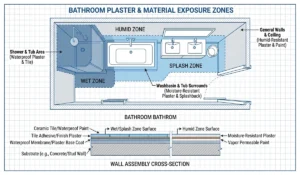
Where services or insulation must sit inside the wall, the dry system almost always wins. A framed cavity, or service void, gives cables, pipework, and insulation somewhere to go without chasing masonry. Acoustic performance is a system property, not a material one. Mass vs isolation are the two routes to sound control. A framed dry wall with a service void and mineral wool can outperform a thin solid wall through isolation rather than mass alone. Drywall vs plaster for soundproofing comes down to which route, mass or isolation, the structure allows. Wet areas change the calculation: see our guide on which system suits a bathroom for the full treatment.
Finish Quality: Monolithic vs Jointed
Finish quality is where gypsum plaster vs gypsum board shows its clearest contrast: monolithic vs jointed. Plaster gives a continuous, monolithic finish with no joints to telegraph through paint. Board gives a jointed surface, and the quality of that joint depends entirely on the finish level applied to it, not on any fixed property of the board itself.
What is a Level 5 finish? Gypsum Association GA-214 defines five recommended levels, from Level 0, no finishing at all, through to Level 5, which adds a full skim coat over the whole board surface. Most specifiers assume a Level 5 finish exists to make the wall perfectly flat. It doesn’t. Its real purpose is to equalise paint porosity across the taped joints and the paper face, so the finished decoration reads as one uniform surface under any lighting.
Joints visible under grazing light are a finish-level problem, not a material fault. Does drywall crack more than plaster? Not usually, when it’s properly jointed. Most visible joint lines are a finish-level mismatch against the room’s lighting, corrected by specifying the right level for that wall, not by blaming the board. Taping and jointing quality, movement joint placement, and the chosen finish level together decide whether a dry system reads as monolithic as a plastered wall. See applying the finish coat for how the wet system achieves its own smooth result.
Where Each System Fails
Which is stronger, drywall or a plaster wall? Neither wins outright. Each system fails in its own characteristic way, and each failure has a specific decision that prevents it.
On the dry side, cracks along board joints usually trace back to structural movement, or to jointing done too fast without following the proper sequence. A planned movement joint, and a jointing sequence that respects drying time between coats, prevents it.
Fixings pulling out of a wall is the classic dry-system failure. How to hang heavy things on plasterboard comes down to planning noggings, or extra framing, for known loads at the design stage, not to relying on standard wall plugs afterward.
Hollow, drummy areas in a bonded board wall trace to insufficient or badly placed adhesive dabs; following the manufacturer’s bonding pattern prevents it.
Board installed before a building is weathertight is a sequencing error. ASTM C840 and GA-216 both guard against it by requiring weather protection first.
On the wet side, decoration delayed for weeks traces to construction moisture that was not allowed to dry before decorating began. Programming the drying time properly, and not decorating early, prevents it. Cracking at wall junctions happens where different backgrounds meet with no allowance for their different movement. Detailing and reinforcing the junction prevents it. A patch repair that never quite matches usually means a different plaster batch, or a different applicator. Keeping repair material from the same batch avoids it.
None of these failures is a defect in the material itself. Every one traces to a decision made, or skipped, before the wall went up. That is exactly why the decision belongs at design stage, not on site after the crack appears.
What You Need to Buy for Each System
Whichever system you build, here is what you need to buy. That’s the honest, practical answer once the decision is made, and it’s worth saying plainly: Rezvan Mines supplies both sides of this comparison.
For the wet system: hand-applied gypsum plaster for the base coat on masonry, block, or concrete, and finishing plaster (white gypsum) for the smooth final surface ready for decoration. Before ordering, most specifiers want to estimate plaster quantities against the actual wall area, rather than guess.
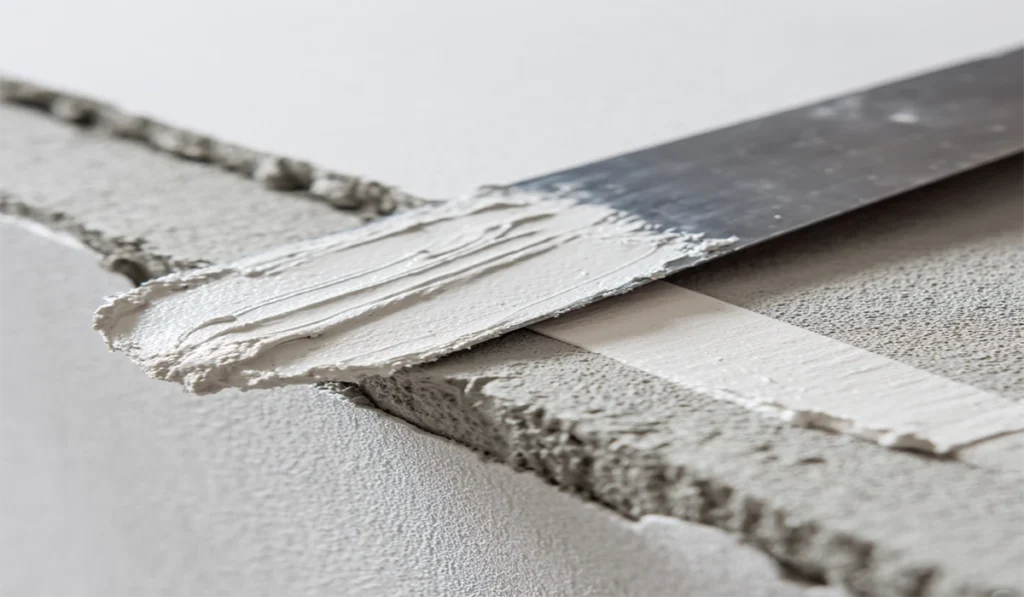
For the dry system: joint filler powder to bed the tape and fill the joints between boards. Then jointing compound (mastic powder) for the finishing coats that bring the wall up to the specified level of finish.
Neither list is longer, or more advanced, than the other among these construction materials. They are simply what each system actually needs. Rezvan Mines has supplied both plastering and jointing materials for over 40 years, which is precisely why this comparison carries no thumb on the scale. We sell the material either way.
We supply both, so tell us which you are building, and we will get you the right technical data sheet and a quotation.
Conclusion
Gypsum plaster vs gypsum board was never a contest to be won. It is a system decision, and the right one depends on the building in front of you, not on habit or supplier preference.
Choose the wet system where a solid background already exists and impact resistance on that background matters. Choose the dry system wherever services or insulation must sit inside the wall, or where programme speed matters more than material cost.
Layer the labour-market reality on top of that: the same decision can flip between a labour-cheap and a labour-expensive market, even on an identical building.
Whichever your project needs, request materials for either system from Rezvan Mines, and we will supply the right one, not the one we would rather sell you.
FAQ
Is drywall better than plaster?
Neither is universally better. The dry system wins on speed, moisture control, and buried services. The wet system wins on monolithic strength and impact resistance. The right choice depends on your building and labour market.
Which is cheaper overall, gypsum plaster or gypsum board?
It depends on the labour market. In labour-cheap markets, wet plaster usually wins on total installed cost. In labour-expensive markets, the dry system usually wins, because programme time carries more cost than material does.
Can you plaster over gypsum board?
Yes, but only with the correct veneer-plaster system and a board designed as a plaster base, such as gypsum lath. Standard wallboard is not designed to receive a full wet-plaster skim coat.
What is the difference between dry lining and plastering?
Plastering applies a wet material directly to a solid background. Dry lining fixes manufactured board, either to a frame or bonded with adhesive dabs, and needs no drying-out period before jointing starts.
Which is stronger, drywall or a plaster wall?
A solid plastered wall generally resists impact better, because there is a solid background behind it. A boarded partition’s strength depends on the board type and the framing behind it.
Does drywall crack more than plaster?
Not when it is properly jointed. Most visible cracking or joint lines trace to structural movement, rushed jointing, or the wrong finish level for the lighting, not to the board itself.
What is a Level 5 finish?
Gypsum Association GA-214 defines it as a full skim coat over the entire board surface. Its purpose is to equalise paint porosity across the joints, not to flatten a wavy wall.
How do you hang heavy items on plasterboard safely?
Standard wall plugs are not enough for real loads. Plan noggings, or extra framing, behind the board at design stage for known heavy items, rather than relying on fixings afterward.