
Plaster setting too fast is the most common complaint on a plastering site. Before you buy a retarder, find out what is actually happening in your bucket.
Why is my plaster setting too fast? In most cases it is not a chemistry problem at all. The mix is losing water to a dry substrate or to hot dry air. That looks identical to a fast set, and no additive will fix it.
This guide separates the two. It then works through the five things you control on site for free, before it discusses additives at all. The diagnostic table in Section 5 matches your symptom to its likely cause — start there if you have material going off right now.
Gypsum plaster setting time is controllable. Most of the controls cost nothing.
What Is Actually Happening When Plaster Sets
Setting is not drying. This is the first thing to get straight, because the two feel the same in the hand and need opposite responses.
Gypsum plaster sets by hydration — a chemical reaction between calcium sulphate hemihydrate and water. The powder dissolves, reacts, and recrystallises as calcium sulphate dihydrate. The reaction gives off heat, so a genuinely setting mix warms up.
That warmth is a useful field test. A bucket that is stiffening and warm is setting chemically. A bucket that is stiffening but stays cool is losing water.
What is the difference between initial set and final set? Initial set is the point where the mix stops being workable and can no longer be placed or reworked. Final set is when it has hardened enough to resist penetration. The gap between them is your finishing window, not your placing window.
ASTM C472 measures setting time two ways: a needle penetration method using Vicat apparatus, and an alternative temperature rise method. The standard itself carries an important caution. It notes that variable job conditions influence setting time, and that the correlation between the laboratory test and service performance has not been determined.
Read that twice. A declared gypsum plaster setting time is a laboratory measurement, not a promise about your wall.
Dissolution, nucleation and crystal growth
The mechanism explains every control that follows. Hemihydrate dissolves into the mixing water. The solution becomes supersaturated with respect to dihydrate — it holds more dissolved material than it can keep in solution.
Dihydrate crystals then nucleate and grow. They grow into each other, forming an interlocking matrix of needle-shaped crystals. That interlocking is what gives set plaster its strength.
Anything that supplies ready-made nuclei speeds this up. Anything that interferes with crystal growth slows it down. Every accelerator and every retarder works on one of those two steps.
Chemical set vs stiffening — the distinction that solves most problems
Here is the centrepiece of this article. A mix can stiffen for two completely different reasons, and they need opposite responses.
Chemical set is hydration running its course. The mix warms, stiffens through its full depth, and will not soften again.
Stiffening by water loss is different. Water leaves the mix into a thirsty background or into hot dry air. The plaster is not setting — it is drying out before it can set. The mix stays cool. The surface often skins over while the material underneath is still soft.
Substrate suction is the usual culprit. A bone-dry AAC block or an unprimed sand-cement background pulls water out of the plaster the moment it touches the wall. Evaporation does the same job on a hot, windy, west-facing elevation.
Adding a retarder to a water-loss problem does nothing useful. It delays a reaction that was never the issue, and it weakens the finished plaster. Control the substrate and the conditions instead. For low-suction and problem backgrounds, see plastering low-suction concrete surfaces.
The Five Things You Control on Site
Gypsum setting time control starts with the things that cost nothing. Work through these five before considering any additive.
Four of the five are free. The fifth — batch size — usually saves money. Additives come after all of them, not instead of them.
There is a clear line here worth naming. A plasterer adjusting water, temperature, batch size and cleanliness is doing normal, skilled work. A plasterer tipping unmeasured chemicals into a bucket is creating a defect. Everything in this section sits on the safe side of that line.
For the trowelling and finishing side of the job, see how to trowel and finish the coat.
1. Water-to-plaster ratio
What is the water to plaster ratio for gypsum? It is not a single number. It is whatever the manufacturer declares for that product, and it is measured as normal consistency.
Normal consistency is the water content that gives a standard flow under a standard test. Each plaster has its own figure, set by its fineness, its additives and its calcination.
More water does extend the working time. It also permanently weakens the set plaster. Excess water leaves voids as it evaporates, and the surface finishes soft, chalky and easy to mark.
That is the trade every site team makes without realising it. Gauging by eye to keep a mix workable is the most expensive free decision on a job. Measure the water. Use the declared ratio.
2. Water and ambient temperature
Does hot water make plaster set faster? Within the ordinary working range, warmer water does speed things up modestly. Cooler water buys you a little more time.
But the effect is smaller than most people expect, and it does not continue indefinitely. Published work in Nature found the induction period of commercial gypsum plaster was essentially constant from 0 °C to 40 °C, and increased gradually above that. The maximum reaction rate peaked only weakly, around 25 °C.
So very hot water is not a shortcut, and it is not a reliable accelerator either. Use cool clean water in hot weather and keep bags out of direct sun.
Ambient conditions usually matter more than water temperature. On a Gulf site in summer, a declared 40-minute working time means very little on a west-facing wall at midday. Shade the work, dampen suction backgrounds, and mix smaller.
3. Mixing time and energy
Mixing does more than combine powder and water. It breaks down agglomerates and exposes fresh surface, which speeds dissolution. Prolonged or high-energy mixing therefore shortens the working window.
Mix to a uniform slurry and stop. Continuing to whip a gauge because the team is not ready to place it actively shortens the time available.
Follow the product’s stated mixing method where one is given. Sprinkling powder into water and letting it soak briefly behaves differently from tipping water onto powder and mixing immediately.
Between gauges, plan the sequence so the mixer is not idle with material in it. The discipline is simple: mix when you are ready to place, not before.
4. Clean tools and containers
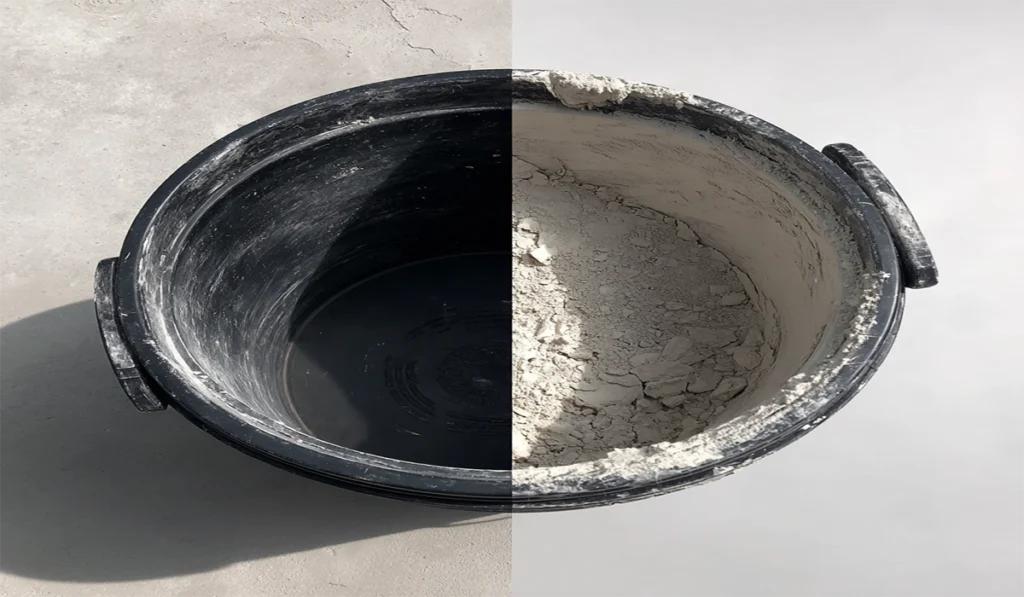
Does a dirty bucket affect plaster setting time? Yes, and dramatically. This is the most common avoidable cause of a fast set on site.
Set plaster residue is calcium sulphate dihydrate. Dihydrate is the most effective accelerator there is, because it works by seeding — it supplies ready-made nuclei so crystal growth starts immediately, skipping the wait for nucleation.
A bucket with a film of set plaster in it, or an unwashed paddle, is dosing every new gauge with accelerator. Nobody measured it and nobody intended it.
The classic symptom is a second batch that sets in half the time of the first. If that is happening, the material is not the problem. Wash the container and the paddle fully between gauges, every time.
5. Batch size and the working window
The working time of plaster is fixed by chemistry. What you control is how much material you ask it to cover.
Plaster pot life is the period from mixing to the point where the material can no longer be placed properly. If the team cannot place and rule off the whole gauge inside that period, the batch is too big. That is a planning decision, not a materials decision.
Here is a threshold worth applying literally. Reduce batch size to what the team can place and rule off inside the declared working time, and split the gauge rather than retarding the mix.
Splitting the gauge solves more set problems than any additive, and it costs nothing but organisation. Before mixing, size your batch before you mix against the area you can actually cover.
Retarders: What They Do and What They Cost You
How much retarder to add to gypsum plaster is the question this section will not answer, and the reason matters more than the answer would.
No honest article publishes a dosage figure for a gypsum retarder. The correct dose depends on the specific plaster, the specific additive, the water ratio, the temperature and the pH of the mix. A figure that works in one plant is wrong in another. Overdosing does not simply delay the set — it can stop the set entirely and permanently reduce strength. Use the additive supplier’s own datasheet, and run a trial batch before any full application.
How to slow down plaster setting chemically means interfering with the reaction. How to slow down gypsum plaster setting time is therefore a question about crystal growth, not about timing. Organic acids such as citric acid and tartaric acid retard the set by inhibiting dihydrate crystal growth. In alkaline conditions they also inhibit the dissolution of the hemihydrate.
Their effect is strongly pH-dependent. Published work reports citric acid reaching its optimum retardation near pH 10, with effectiveness declining beyond that. A retarder is therefore not a fixed-strength product — it behaves differently in different mixes.
Now the part that gets left out of product pages. A retarder is never a free delay. It changes the crystal structure, not just the timing.
Published research reports tartaric acid producing agglomerated, poorly formed crystals with reduced compressive strength. Citric acid and potassium citrate produce well-formed prismatic and needle-shaped crystals, with better retention of properties. Other work reports citric acid changing dihydrate crystals from needle-like towards short columnar and plate-like forms, weakening the overlap between crystals.
The practical conclusion is simple. Longer set generally means some strength loss, and which plaster retarder you use changes how much. Treat any set control additive as a formulation decision, not a site decision — and always trial it before it goes on a wall.
Accelerators: When You Actually Need One
How to speed up gypsum plaster setting is a rarer problem, but a real one. Cold weather, a heavily retarded product, or a fast-turnaround programme can all leave a mix setting too slowly.
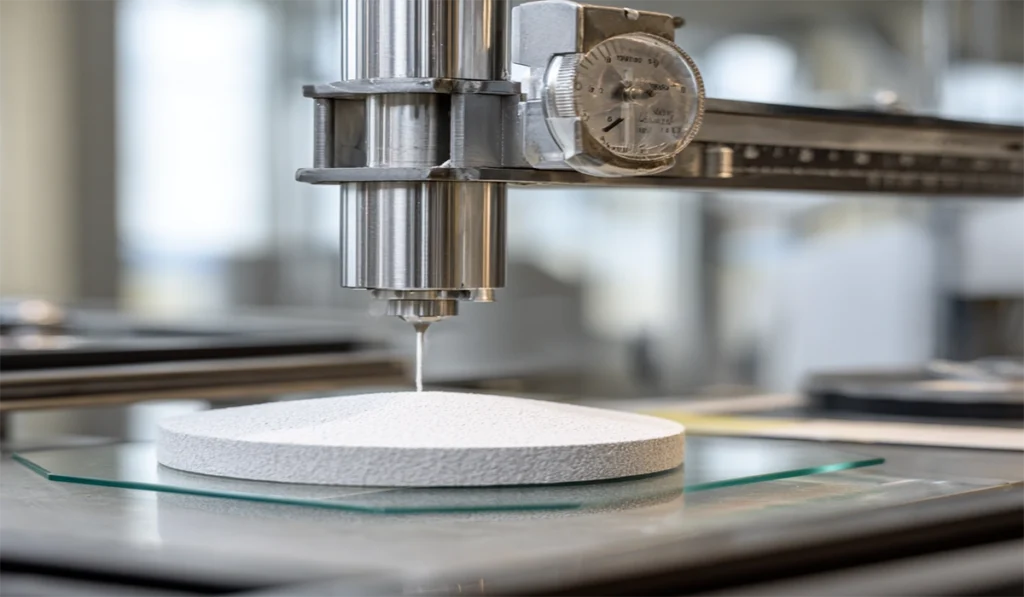
Calcium sulphate dihydrate is the most common gypsum accelerator. It works by seeding, supplying ready-made nuclei so crystal growth begins sooner rather than waiting for nucleation to start on its own.
Ball-milled dihydrate accelerators are often co-ground with sugar or starch. There is a practical reason: the accelerator loses potency if residual heat during bagging partly calcines it, or simply through ageing. A coating protects it.
Aluminium sulphate, zinc sulphate and potassium sulphate are also documented set accelerators.
The same discipline applies here as with retarders. No dosage figures, the supplier’s datasheet governs, and a trial batch comes before any full application. An over-accelerated mix that goes off in the bucket wastes material and time.
Note also that a slow set with a soft, chalky surface is usually not an accelerator problem. That is too much mixing water, and adding accelerator will not fix it. Diagnose before you dose.
Storage matters for accelerators too. An accelerator that has aged or absorbed moisture will underperform, and the natural response — adding more — produces an erratic set rather than a faster one. Keep it sealed, dry, and within its stated life.
Diagnosing a Set Problem
Match your symptom to the row below before you change anything. Most problems are identified in under a minute.
| Symptom | Most likely cause | What to do |
| Mix stiffens in minutes, warm to the touch | Genuine fast chemical set — contamination, aged material, or over-calcined plaster | Check the bucket and tools first, then the bag date, then the material |
| Surface skins over but the mix underneath is still soft | Water lost to hot dry air, not chemical set | Control site conditions; do not add retarder |
| Plaster stiffens as soon as it touches the wall | Substrate suction — a dry, thirsty background | Control the substrate; do not change the mix |
| Set time varies bag to bag from the same pallet | Uneven storage, moisture ingress in part of the batch | Check storage; review the material with the supplier |
| Set is slow and the finished surface is soft and chalky | Too much mixing water | Return to the declared water ratio |
| Mix will not set at all | Retarder overdosed | Discard the batch; never try to rescue it |
| Material sets faster than it did last month | Bags have aged; partial rehydration has created dihydrate seed | Rotate stock; use oldest first, within shelf life |
| Second batch sets faster than the first | Tools not cleaned between batches | Wash tools and container fully between gauges |
The first three rows cover most complaints, and two of the three are not chemistry problems at all.
Work the rows in order of cost. Checking a bucket is free and takes seconds. Checking a bag date takes a minute. Blaming the material is the last step, not the first, and it is the step most sites reach for first.
The temperature check settles the top two rows on its own. Put a hand on the side of the container. A genuinely setting mix generates heat, because hydration is exothermic. If the mix is stiffening but the bucket is cool, water is leaving the mix rather than reacting in it. That single test redirects the whole diagnosis.
Can you add water to plaster after it starts setting? No. Re-tempering plaster breaks the crystal matrix that has already formed, and it cannot re-form properly. The plaster will look workable again and will set soft, weak and dusty.
One site team kept adding water to keep a mix moving through a hot afternoon. They read plaster hardening too quickly as a water problem, when it was a batch-size problem. The wall looked acceptable on the day. Two weeks later the surface failed inspection: soft, powdery, and marking under a fingernail.
The bottom row is worth its own note. If a second batch consistently goes off faster than the first, stop looking at the material entirely. Nobody washed the paddle.
If a gauge has started to go off, discard it. The cost of the wasted material is far below the cost of stripping a failed wall.
When the Problem Is the Material, Not the Method
Sometimes the method is sound and the material genuinely has changed. Two causes account for most of it.
Why does old plaster set faster? Because bags age. Gypsum plaster is hygroscopic — it picks up moisture from humid air. Partial rehydration converts a little hemihydrate at the particle surfaces into dihydrate, and that dihydrate acts as seed. The bag is effectively self-accelerating.
Storage decides how fast this happens. Bags stacked against an outside wall through a humid season behave very differently from bags kept dry, off the floor and away from external walls. In 40-plus years of production, storage conditions explain more set-behaviour complaints than material variation does.
The fix is stock rotation. Use oldest first, within the stated shelf life, and store under cover on pallets. Caking in the bag is a warning sign, not a cosmetic one.
Over-calcination is the second cause. If plaster is heated too far during manufacture, part of the hemihydrate converts to soluble anhydrite, which hydrates very rapidly. The result is a fast, sometimes erratic set that no site adjustment will tame.
That one is not yours to fix. If set time varies bag to bag from the same pallet, and storage is sound, raise it with the supplier and quote the batch numbers.
Specifying Setting Time When You Order
A gypsum plaster setting time on a datasheet is only meaningful with its test conditions attached.
EN 13279-2 specifies laboratory conditions of 23 ± 2 °C and 50 ± 5 % relative humidity. That is why a declared figure rarely matches a hot, dry site. It was never measured in your conditions.
So ask your supplier for the declared setting time and the test conditions behind it. A set time with no temperature and no humidity tells you nothing.
Then measure it in your own conditions. A short trial gauge on site, timed with a watch, tells you more about your job than any datasheet can. Where the honest answer is “it depends on your site”, this is how you close the gap.
Then specify to the application. Rezvan Mines supplies products both retarded and unretarded. State the working time the job needs rather than accepting a default. Hand-applied gypsum plaster and finishing plaster (white gypsum) serve different stages and different windows.
For how the figure is derived and printed, see how setting time is measured and declared. To get the numbers for your job, ask for the declared setting time and test conditions.
Conclusion
Most plaster that appears to set too fast is not setting fast at all. It is losing water to a thirsty substrate or to hot dry air. A warm bucket means chemistry; a cool one means water loss, and the two need opposite responses.
Two decisions follow from that. First, work through the free controls before reaching for a bottle. Clean tools, the declared water ratio, sensible water temperature, controlled mixing, and a batch sized to what the team can place. Second, treat additives as a formulation decision with a real cost, dosed from the supplier’s datasheet and proven on a trial batch every time.
For the application side of the same job, see how to trowel and finish the coat, and ask for the declared setting time and test conditions before your next order.
FAQ
Why is my plaster setting too fast?
Check the bucket first. Set plaster residue seeds the new mix and accelerates it sharply. Then check the bag date and storage. If the mix stays cool while stiffening, it is losing water rather than setting.
Does hot water speed up the set?
Within the ordinary working range, warmer water accelerates the set modestly. The effect is smaller than expected. Published work found the induction period roughly constant from 0 to 40 °C, then increasing above that. Very hot water is not a reliable accelerator.
Can I add water once it starts to stiffen?
No. Re-tempering breaks the crystal matrix already formed, and it cannot rebuild properly. The plaster will appear workable but sets soft, weak and dusty. Discard the gauge and mix a smaller one.
How much retarder should I use?
No honest source publishes a figure. The correct dose depends on the plaster, the additive, the water ratio, temperature and pH. Overdosing can stop the set completely and reduce strength permanently. Follow the additive supplier’s datasheet and trial it first.
Why does an old bag set faster than a new one?
Gypsum plaster absorbs moisture from humid air. Partial rehydration creates dihydrate at particle surfaces, which acts as seed and accelerates the set. Rotate stock, use oldest first within shelf life, and store dry and off the floor.
What is the difference between initial and final set?
Initial set is when the mix stops being workable and can no longer be placed. Final set is when it has hardened enough to resist penetration. The interval between them is your finishing window, not your placing window.
Will a retarder weaken my plaster?
Usually to some degree. Retarders change crystal shape, not just timing. Research reports tartaric acid producing poorly formed crystals with reduced compressive strength, while citric acid and potassium citrate retain properties better. Longer set generally means some strength loss.
Why does plaster stiffen the moment it touches the wall?
That is substrate suction, not setting. A dry, thirsty background pulls water out of the plaster on contact. Control the background rather than the mix — a retarder will not help, and will weaken the finished plaster.