
Estimators who calculate from set density rather than from the bag label order the right quantity first time. The bag figure is a laboratory yield; the site figure is always higher.
Use the gypsum plaster calculator below to get your number now. The plaster coverage calculator takes the area, the coating thickness, and the plaster type, and returns kilograms, bags, pallets and container loads. The guide underneath explains where the number comes from and which six factors push it up. It also covers how much wastage to allow before ordering.
Gypsum Plaster Coverage Calculator
Enter your area, thickness and plaster type. Results update as you type.
- —kg total
- —bags
- —pallets (— bags each)
- —× 20 ft container —× 40 ft container
How Gypsum Plaster Coverage Is Actually Calculated
Estimators who state their assumptions produce numbers an engineer will accept — the assumption is the evidence, not the total.
Gypsum plaster consumption per square meter is not a property of the product. Ask how much gypsum plaster per square meter a job needs and the answer is three numbers you choose. Those are the area covered, the thickness applied, and the set density.
Knowing how to calculate gypsum plaster quantity for a wall means fixing those three, then adding an allowance for what happens on site. Everything else in this guide is about that allowance, because that is where estimates go wrong.
The core formula: area × thickness × set density
The theoretical yield calculation is one line:
kg required = area (m²) × thickness (m) × set density (kg/m³)
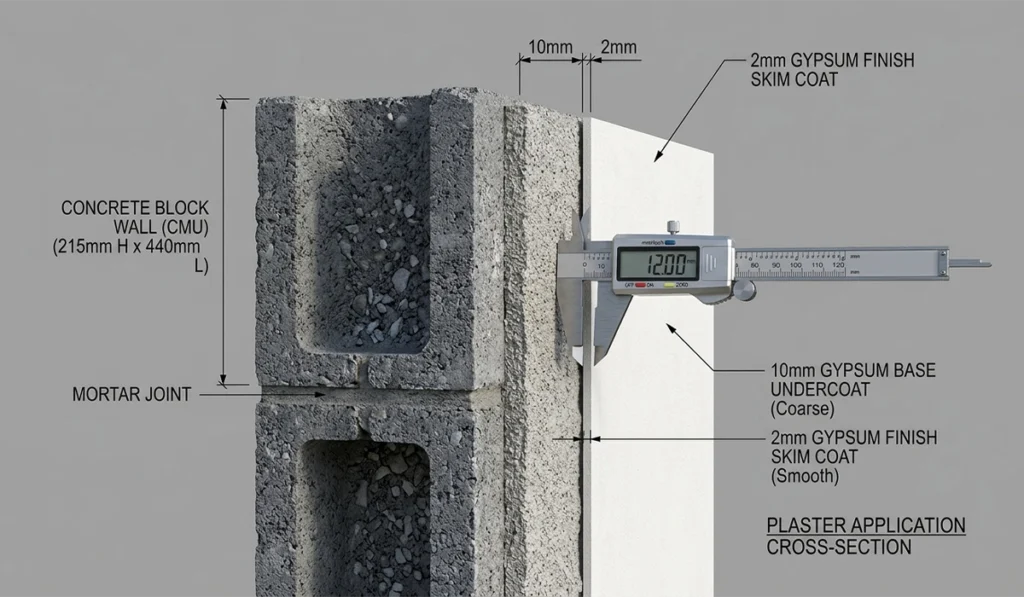
Thickness must be in metres, so 10 mm becomes 0.010. If the set density of your product is 1,000 kg/m³, then 0.010 × 1,000 gives 10 kg per square metre.
So how many kg of gypsum plaster per m2 at 10 mm thickness? Ten, at that density — and proportionally more or less as the density changes. Take the density from your supplier’s Technical Data Sheet rather than from a general figure, because it varies by product.
Why the figure on the bag is not the figure on site
Theoretical coverage assumes a perfectly flat substrate, exactly uniform thickness, and no losses. No wall meets that description.
Actual consumption runs above theoretical for four reasons. The substrate is not flat, applied thickness varies, material falls off the hawk and wall, and part-used bags are lost. This is why a crew that “should” use 30 bags collects 34.
The gap is normal and predictable. Gypsum plaster wastage percentage on site typically sits between 5% and 15%, depending on substrate and crew. That range belongs in the estimate, not in the apology afterwards.
Typical Coverage Figures by Plaster Type
Buyers who use their own product’s declared density get a defensible figure — a generic table gives a starting point, nothing more.
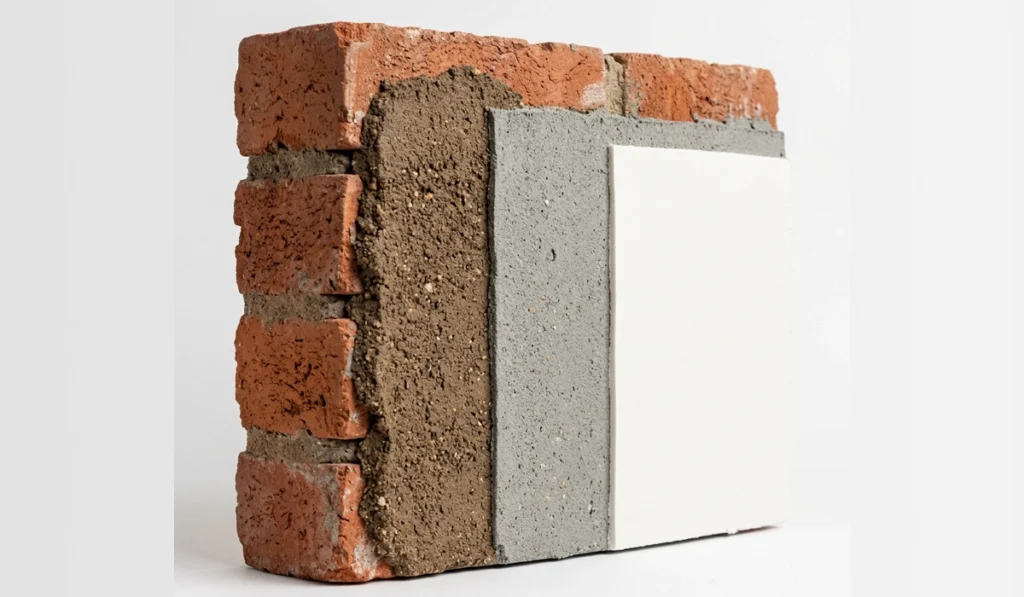
Coverage differs by plaster type mainly because set density differs. A lightweight machine plaster and a dense finishing plaster produce very different gypsum plaster coverage per m2 at the same thickness. The gypsum plaster spread rate follows density directly. The table below shows the relationship rather than fixed values.
| Plaster type | Typical applied thickness | Set density basis | kg/m² at stated thickness | Notes |
| Base / undercoat | 10–15 mm | Standard density | Thickness × density ÷ 1,000 | Bulk of the material on most jobs |
| Hand-applied gypsum | 10–13 mm | Standard density | Thickness × density ÷ 1,000 | Most common on wall work |
| Machine-applied gypsum | 8–12 mm | Often lighter | Thickness × density ÷ 1,000 | Lower density reduces kg/m² |
| Finishing plaster (white) | 1–3 mm | Higher density | Thickness × density ÷ 1,000 | Thin coat, small total quantity |
| Putty powder | 1–2 mm | Higher density | Thickness × density ÷ 1,000 | Skim only |
Finishing plaster coverage per m2 is always far lower than base coat coverage, simply because the coat is thinner. For finishing plaster (white gypsum), hand-applied gypsum plaster and putty powder, the declared density is on the datasheet for each grade.
Six Factors That Change Your Real Consumption
Site teams who measure substrate deviation before ordering avoid the 30% overruns that flat-wall assumptions produce.
Six things move actual consumption away from the theoretical figure.
Substrate flatness is the largest. An out-of-plumb wall is corrected in plaster, and every millimetre of correction is material.
Substrate suction matters in hot, dry conditions. Dry blockwork pulls water from the mix, which changes workability and encourages the crew to apply thicker.
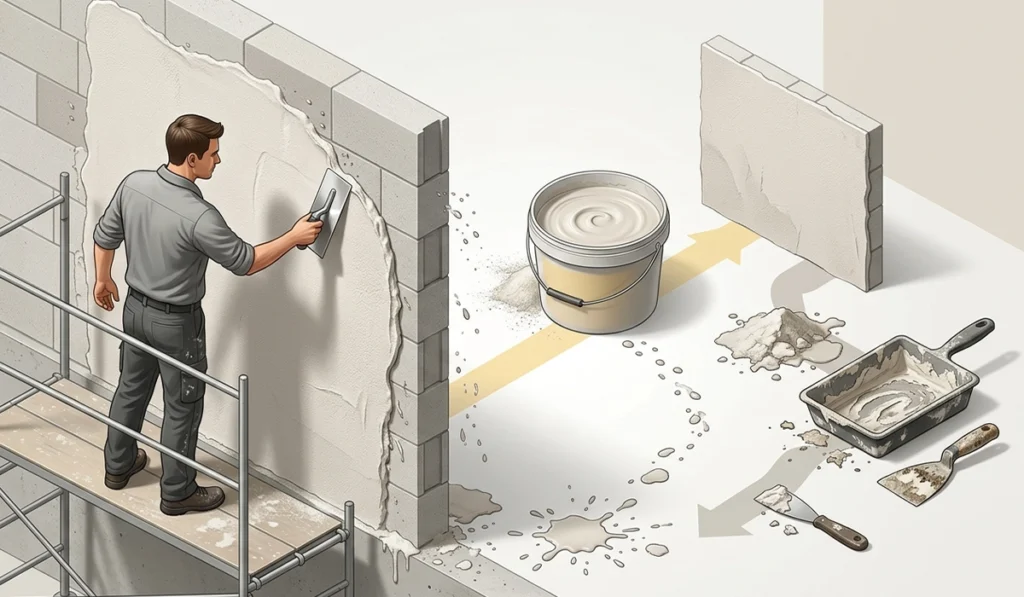
Application method changes losses. Machine application is generally more consistent than hand work, and how to apply a finish coat correctly affects how much of the mix reaches the wall.
Plaster thickness per coat drifts upward under time pressure. A nominal 10 mm often measures 12 or 13.
Water ratio affects both strength and spread. Adding water beyond the declared ratio makes the mix easier to spread but weakens the set surface.
Element type matters: gypsum plaster consumption for ceiling vs wall differs, because overhead work loses more material and is usually applied slightly thinner.
Substrate suction and surface flatness
Brickwork and smooth concrete behave in opposite ways, and both raise consumption for different reasons.
Brickwork and blockwork are absorbent and rarely flat. Suction pulls water from the mix and mortar joints create hollows that fill with plaster. Smooth concrete is flat but non-absorbent, so bond is the problem rather than suction — plastering smooth concrete surfaces needs a different preparation.
Measure deviation before estimating. Allow 15% wastage when substrate deviation exceeds 10 mm over a 2 m straightedge.
Thickness control and dubbing out
Crews who dub out low spots first keep the finish coat at nominal thickness — the correction happens once instead of across the whole wall.
Dubbing out means filling deep hollows in a separate operation before the main coat. Without it, the plasterer raises the thickness of the entire wall to bury the low spots.
Screed rails fix the plane so the straightedge has something to work to. Both practices control the single variable that dominates material use.
How Much Wastage to Add — and Why 10% Is Not Always Enough
Estimators who set the gypsum plaster wastage factor from substrate condition, not habit, stop running short mid-job.
Ten percent is the default in most plastering material estimation, and it is reasonable for flat, prepared substrates worked by an experienced crew.
It is not enough in three situations. Uneven or out-of-plumb substrates need 15% or more, because correction material is not wastage in the ordinary sense — it is real applied volume nobody measured. Small or heavily interrupted rooms lose proportionally more to part-batches. And inexperienced crews lose more from the hawk and the floor.
Add the allowance as a stated percentage, so the assumption travels with the number rather than disappearing into a total. A reviewer can then agree or disagree with the percentage itself. An estimate that says “70 m² at 10 kg/m² plus 15%” can be checked. One that says “800 kg” cannot.
Worked Example: A 4 m × 5 m Room, Step by Step
Estimators who calculate walls and ceilings separately avoid both the shortfall and the over-order.
This gypsum plaster quantity calculation uses a room 4 m × 5 m with a 3 m ceiling height, plastered at 10 mm. The set density is taken as 1,000 kg/m³ — an assumption, so substitute your own TDS value.
Step 1 — wall area. Perimeter 2 × (4 + 5) = 18 m. Multiply by height: 18 × 3 = 54 m². Deduct one door and one window at roughly 4 m² total, giving 50 m².
Step 2 — ceiling area. 4 × 5 = 20 m². Total area 70 m².
Step 3 — kg per m². 0.010 m × 1,000 kg/m³ = 10 kg/m².
Step 4 — base quantity. 70 × 10 = 700 kg.
Step 5 — wastage. Add 10% for a sound substrate: 770 kg.
Step 6 — bags. At 25 kg, 770 ÷ 25 = 30.8, so order 31 bags. That answers how many bags of gypsum plaster for one room of this size.
Scaling up, how much gypsum plaster do I need for 100 square meters at the same assumptions? 1,000 kg base, 1,100 kg with wastage, or 44 bags of 25 kg.
Estimating Mistakes That Blow the Material Budget
Estimators who check the six failures below before ordering catch nearly all of the overruns that reach a variation claim.
Ran out mid-job. Theoretical coverage was used with no wastage allowance. Add a stated percentage based on substrate condition.
Consumption 30–40% above estimate. The substrate was uneven and thickness crept from 10 mm to 14 mm. Dub out the low spots first and use screed rails.
Over-ordered by tonnes. Wall rates were applied to ceilings. Calculate ceilings separately.
Weak, soft surface. Too much mixing water was added to stretch the material. Follow the declared water-to-plaster ratio.
Bags hardened in store. Humidity reached the material before use. Order to schedule and store sealed, off the floor.
Container under-filled, demurrage charged. Kilograms were converted to pallets without checking the pallet footprint. Confirm the pallet and container arithmetic before booking.
From Calculation to Order: Bags, Pallets and Containers
Buyers who confirm pallet footprint with the shipper before booking avoid both demurrage and an under-filled container.
Converting a plastering material take-off into an order takes three steps. Divide total kilograms by bag size and round up. Divide bags by the number per pallet. Then check what the container will actually hold.
The last step is where orders go wrong. How many tonnes of gypsum plaster in a 20 ft container depends on pallet dimensions, stacking height, and route payload limit. There is no single universal figure. Confirm all three with your freight forwarder, and read our guide to bulk gypsum shipping and packaging before finalising.
State gypsum plaster coverage per bag on the purchase order, alongside thickness and assumed density. That lets the supplier sanity-check the quantity before dispatch. Rezvan Mines has produced and processed gypsum for over 40 years, with SGS-inspected quality control. You can request a quotation once you have a total.
Conclusion
The whole calculation is area × thickness × set density, plus a stated wastage allowance. Everything else is knowing which density to use and how much the substrate will add.
Take the density from the datasheet, not from a general table. Measure substrate deviation before fixing the wastage percentage. Calculate ceilings separately from walls. Then confirm the pallet and container arithmetic before you book the shipment.
Run your figures through the calculator above, then request a quotation with the thickness and density you used.
FAQ
How do you calculate plaster quantity?
Multiply the area in square metres by the thickness in metres, then by the set density in kilograms per cubic metre. Add a wastage allowance based on substrate condition. Take the density from the product Technical Data Sheet rather than a general industry figure.
How many square meters does a 25 kg bag of gypsum plaster cover?
It depends on thickness and density. At 10 mm and a set density of 1,000 kg/m³, one square metre needs 10 kg. A 25 kg bag therefore covers 2.5 m². Halve the thickness and it covers twice the area.
What is the standard thickness for gypsum plaster?
Base and undercoat work is commonly applied at 10 to 15 mm on walls. Finishing plaster and putty are much thinner, usually 1 to 3 mm. Confirm the range for your specific product, since declared thickness varies between grades.
Why did I use more plaster than the bag said?
The bag figure is a theoretical yield assuming a flat substrate and exact thickness. Real walls are uneven, applied thickness drifts upward, and material is lost from the hawk and floor. Consumption above the theoretical figure is normal, not a defect.
Is gypsum plaster coverage the same on ceilings?
No. Overhead work loses more material during application, and ceilings are usually finished slightly thinner than walls. Calculate ceiling areas separately using their own thickness figure rather than applying the wall rate to the whole room.
How much wastage should I allow for plastering?
Ten percent suits a flat, well-prepared substrate and an experienced crew. Allow 15% or more where deviation exceeds 10 mm over 2 m, in small interrupted rooms, or with a less experienced team. State the percentage in the estimate so it can be checked.