
You are probably holding two or three quotations that look nothing like each other. One is 8% cheaper. Another arrived on different terms. None of them explains what is actually included.
This page does not publish a gypsum powder price per ton, and the reason matters. Any figure printed here would be wrong within weeks. A stale number on a producer’s own site is worse than no number at all. Ask how much does a ton of gypsum powder cost and the honest answer is seven things. You can identify each one, compare it across offers, and in most cases negotiate it.
What follows is the mechanism behind every quotation you receive. It includes a worksheet that makes three offers comparable, and what to send us for a real figure.
Why No Honest Supplier Publishes a Fixed Price
Buyers who understand the cost build-up stop chasing a headline rate and start comparing like with like.
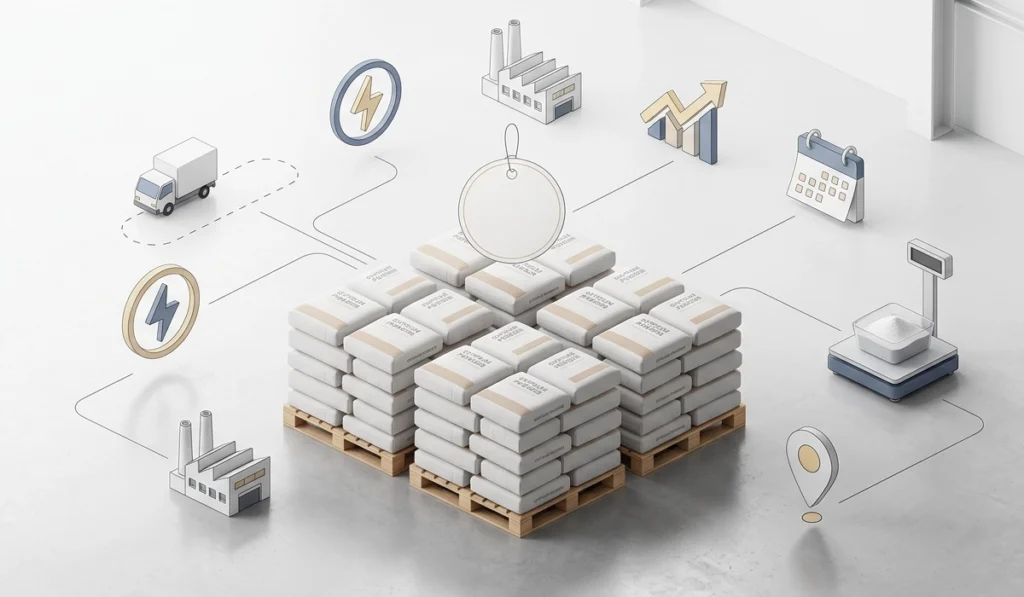
A gypsum price per ton is not one number. It is a stack of costs assembled for a specific grade, packaging, quantity, destination and payment arrangement. Change any one and the total moves. A published figure would have to assume all five, and would therefore be right for almost nobody.
So why are gypsum quotes so different between suppliers? Usually because they are not quoting the same thing. One includes palletised bagging and inland haulage; the next is ex-works in bulk. The unit rates differ by 8% and the delivered cost differs by far more.
There is a second reason worth stating plainly. A supplier who cannot explain their own cost build-up usually has something in it they would rather not discuss. A trader buying calcined material and reselling it has a margin to protect and an origin to obscure. Rezvan Mines produces directly rather than trading, which is why the structure below can be set out openly.
The Seven Factors That Set Your Price
Buyers who identify which of the seven factors they can move negotiate on substance instead of haggling on the headline.
Reference: ICC Academy — Incoterms® 2020 rules — Training authority on how trade terms allocate cost and risk.
Seven variables set the gypsum powder price per ton on your quotation. Two are fixed by the material, three by how it travels, and two by how you buy. Knowing which is which tells you where negotiation is realistic and where it is not.
The first two are largely outside your control once the specification is fixed. The middle three are where most buyers leave money behind, because they are treated as logistics detail rather than as price. The last two are the ones a prepared buyer moves most easily.
1. Grade and specification
Buyers who fix the specification before requesting quotes receive numbers they can compare directly.
Grade is the largest single driver. Raw gypsum stone is cheaper per tonne than calcined powder because it has not been through a kiln. Within calcined products, a finishing grade costs more than a base grade, and putty powder carries a different rate again.
Purity, whiteness and fineness all move the figure. Before comparing offers, check the specification behind the price. A lower wall putty powder price on a coarser grade is no saving if the finish needs two coats.
2. Energy and the cost of calcination
Calcination is heat, and heat is fuel. Converting gypsum rock into hemihydrate powder means driving off chemically bound water in a kiln. Kiln fuel is a real line in the cost stack.
This is why raw stone and calcined powder move differently in price. A change in energy cost passes through to powder far more than to stone.
It also explains why a producer with its own deposit and processing quotes differently from a trader buying calcined material and reselling it. One is exposed to fuel cost; the other is exposed to someone else’s margin. When energy prices move sharply, the two respond on different timescales, which is worth knowing if a quotation is about to expire.
3. Packaging and palletising
Does packaging affect the gypsum price? More than most buyers expect, and it is the most common hidden difference between two offers.
Bulk is cheapest per tonne. FIBC jumbo bags cost more. Small bags cost more again, and palletising and shrink wrapping add another layer. A gypsum powder price per 25 kg bag therefore sits well above the bulk equivalent, for reasons that have nothing to do with the material.
Watch the unit as well as the number. A gypsum price per kg and a rate per tonne describe the same material, and converting between them is where arithmetic errors creep into comparisons. On gypsum price bulk vs bagged, the comparison only works once both quotes state the same packaging. How the material is packed and protected is covered in our guide to how bulk gypsum is packed and shipped.
4. Incoterms — what the price actually includes
Buyers who insist every quotation uses one stated Incoterm remove the largest source of false comparison.
Incoterms® 2020 is published by the International Chamber of Commerce and took effect on 1 January 2020. It contains 11 rules. Seven apply to any mode of transport — EXW, FCA, CPT, CIP, DAP, DPU and DDP. Four apply only to sea and inland waterway transport: FAS, FOB, CFR and CIF.
What does FOB include in a gypsum quotation? Free On Board covers the product, packing, loading, inland haulage to the port, export clearance and origin terminal handling. It stops there. Ocean freight, insurance, destination charges and duty are yours. A gypsum FOB price is therefore never comparable to a CIF figure without adding those lines back in.
One point most gypsum pricing articles miss: the ICC recommends FCA rather than FOB for containerised cargo. Always cite the rule in full, as “FOB Bandar Abbas (Incoterms® 2020)”.
5. Freight and container economics
Buyers who ask whether a freight element is firm or indicative avoid the revision that arrives after booking.
Freight is the most volatile component of any gypsum export price. It moves with route, season, equipment availability and fuel, and it is often quoted separately from the material.
How many tons of gypsum fit in a 20 ft container? It depends on the payload limit for your route, the packaging, and whether the load weighs out before it cubes out. Gypsum is dense, so containers usually weigh out first — confirm the figure with your forwarder rather than assuming a standard.
Ask for a bulk-vessel quotation only once annual volume justifies a full parcel. Below that, containerised will land cheaper despite the higher unit rate.
6. Order size, MOQ and scheduling
Buyers who plan ahead pay less, because production scheduling is a genuine price lever rather than a courtesy.
Volume moves the rate in the obvious direction. The minimum order quantity for gypsum powder export is set by packing line efficiency and container economics, not arbitrary policy. It differs by product and packaging.
Timing matters as much as size. A rushed order competes with scheduled production, and that shows up in the price. A spot purchase and a contract commitment attract different bulk gypsum price levels for the same material. One carries planning certainty; the other does not. Buyers who forecast a quarter ahead consistently pay less than buyers who order when the warehouse empties.
7. Payment terms, inspection and certification
Buyers who separate the financing cost from the material cost see what they are actually paying for each.
Payment terms carry a real cost. A letter of credit at sight prices differently from a long-dated LC, because the seller is financing the gap. That financing appears inside the unit rate rather than as a separate line.
Inspection and certification add cost too. Pre-shipment inspection through SGS, Intertek or Bureau Veritas is worth having, but it is a service someone pays for. So is a certificate of origin. A gypsum supplier price that includes both is not directly comparable to one that excludes them.
Comparing Quotations: The Landed-Cost Worksheet

Buyers who rebuild every offer into one worksheet identify the genuinely cheapest supplier rather than the lowest headline.
Learning how to calculate landed cost of imported gypsum takes one table. Map each quotation onto it, fill the gaps with your own figures, and compare totals rather than unit rates. The same worksheet handles a gypsum plaster price per ton offer and a raw stone offer equally well. It compares cost lines rather than products.
Work through it line by line for each supplier. Where a cell is blank on their quotation, that cost has not disappeared. It has moved to you, and it belongs in your column before any comparison means anything.
| Cost line | EXW | FOB | CFR | CIF | Who usually pays it otherwise |
| Product, ex-works | ✔ | ✔ | ✔ | ✔ | — |
| Packaging and palletising | Confirm — often quoted separately | ✔ | ✔ | ✔ | Buyer, if excluded |
| Loading at the plant | ✘ | ✔ | ✔ | ✔ | Buyer |
| Inland haulage to port | ✘ | ✔ | ✔ | ✔ | Buyer |
| Export clearance and documents | ✘ | ✔ | ✔ | ✔ | Buyer |
| Terminal handling at origin | ✘ | ✔ | ✔ | ✔ | Buyer |
| Ocean freight | ✘ | ✘ | ✔ | ✔ | Buyer |
| Marine insurance | ✘ | ✘ | ✘ | ✔ | Buyer |
| Terminal handling at destination | ✘ | ✘ | ✘ | ✘ | Buyer |
| Import duty and taxes | ✘ | ✘ | ✘ | ✘ | Buyer |
| Inland delivery at destination | ✘ | ✘ | ✘ | ✘ | Buyer |
| Demurrage and detention risk | ✘ | ✘ | ✘ | ✘ | Buyer |
Packaging is the single most common hidden variable between two quotations that look comparable. One EXW offer may exclude bagging entirely while the other includes it, and nothing on either document says so.
One insurance note. Under Incoterms® 2020, CIF requires cover at Institute Cargo Clauses (C), the minimum level. CIP requires the higher Clauses (A) cover. Both are set at a minimum of 110% of contract value.
Market Forces You Do Not Control
Buyers who track supply-side direction time their contracts better than buyers who only track quotes.
Some gypsum price factors sit outside any negotiation. Energy cost moves calcination cost. Freight markets move independently of the material. Currency movement affects every cross-border quotation.
Supply direction matters too. By-product gypsum from power-station scrubbers is tied to coal generation, which is contracting in several markets. Our guide to why supply is tightening covers what that means for sourcing.
None of these can be negotiated with a supplier, but all of them can be timed. A buyer who knows freight is easing waits a fortnight; a buyer who knows supply is tightening commits early.
Commodity pricing rewards the buyer who commits when conditions are favourable rather than when the stock runs out. Fix the price validity period and the payment milestone in writing on every offer you accept.
Where Buyers Lose Money on Price
Buyers who check the eight failures below before signing recover more than any negotiation on unit rate would deliver.
The cheapest quote lands most expensive. Unit price was compared instead of the landed cost of gypsum delivered to your gate. Build every quotation into the same worksheet before choosing.
Unexpected charges appear at destination. The buyer purchased FOB or CFR without mapping destination costs. List destination terminal handling, duty and inland delivery before comparing.
Quotes are not comparable. Different Incoterm, packaging and grade. Request every quote on one stated basis.
A risk gap opens during terminal storage. FOB was used for containerised cargo. Use FCA for containers and align the letter-of-credit wording.
Demurrage eats the saving. Documents were late or incomplete. Agree the document set and timing in the contract.
Material is cheaper but yield is worse. A lower grade was bought on price alone. Work out cost per square metre, not just per tonne.
Price rises before shipment. The offer had open-ended validity. Fix the validity period.
Freight is quoted separately, then revised. It was never fixed at booking. Confirm whether the freight element is firm or indicative.
How to Get an Accurate Quotation
Suppliers who receive four pieces of information return a firm number; suppliers who receive one return a range.
A useful gypsum quotation needs four inputs: the grade or specification, the quantity, the packaging, and the destination port. Add your preferred Incoterm and payment terms and the figure comes back firm rather than indicative.
Send those and we will return a quotation with a stated validity period [CONFIRM turnaround time with the commercial team before publishing]. Rezvan Mines has produced and exported gypsum for over 40 years across China, Japan, India, Turkey and the Arab region. SGS and Intertek inspection is available on request.
We do not claim to be the cheapest — that claim is unverifiable from either side. We do claim to explain the build-up. Browse the full product range, then request a quotation.
Conclusion
No producer can publish a fixed gypsum powder price per ton. The number is assembled from grade, energy, packaging, trade terms, freight, order size and payment structure. Change one and the total changes.
What you can do is make three quotations comparable. Put them on one Incoterm, one packaging specification and one grade. Rebuild each into the landed-cost worksheet. Then compare the totals, not the headline rates — the cheapest unit price is frequently not the cheapest delivered tonne.
Send the grade, quantity, packaging and destination port, and request a quotation you can put straight into the worksheet.
FAQ
How much does a ton of gypsum powder cost?
There is no single figure. The rate depends on grade, packaging, order quantity, trade term, destination and payment structure. Any published number would be wrong within weeks. Send a specification and destination port to receive a firm quotation instead of a range.
What is the FOB price of gypsum powder?
Free On Board covers product, packing, loading, inland haulage to port, export clearance and origin terminal handling. It excludes ocean freight, insurance and everything at destination. The FOB figure itself varies by grade and packaging, so request it against a stated specification.
Why are gypsum quotes so different between suppliers?
Usually because they are not quoting the same thing. Different Incoterms, packaging and grades produce numbers that cannot be compared directly. Ask every supplier to quote one specification, one packaging format and one Incoterm, then rebuild each offer into a landed-cost worksheet.
How many tons of gypsum fit in a 20 ft container?
It depends on the route payload limit, the packaging format and whether the load weighs out before it cubes out. Gypsum is dense, so weight is usually the binding constraint. Confirm the figure with your freight forwarder for your specific route.
Does packaging affect the gypsum price?
Significantly. Bulk is cheapest per tonne, FIBC jumbo bags cost more, and small bags with palletising and shrink wrap cost more again. Packaging is the most common hidden difference between two quotations that appear comparable on unit rate.
What is the minimum order quantity?
It varies by product and packaging, and is driven by packing line efficiency and container economics rather than arbitrary policy. Ask for the MOQ alongside the quotation, since a lower unit rate at a higher minimum may not suit your requirement.