
For industrial buyers, gypsum rock export specifications are the single most important filter separating a profitable shipment from a rejected container. These specifications govern chemical purity, physical grading, and contamination thresholds. Getting them wrong means production losses downstream.
This guide breaks down the technical parameters that procurement teams, plant managers, and trading houses must verify before signing a purchase order. The aim is to give you a defensible checklist rooted in mineralogy and trade practice.
Rezvan Mines supplies graded material against documented gypsum rock export specifications, and this article reflects the standards we apply at the quarry face.
Why Export Specifications Define Your Gypsum Supply Chain
Gypsum is not a uniform commodity. Two quarries in the same region can yield rock with materially different sulfate content, whiteness, and impurity profiles. That variability is precisely why written gypsum rock export specifications exist.
A cement plant blending gypsum as a set retarder cares about CaSO4·2H2O content and chloride limits. A plasterboard manufacturer cares about whiteness and calcination behavior. The same rock cannot serve both buyers equally.
Treating gypsum as interchangeable is the most common—and most expensive—sourcing error. Specification mismatch shows up as off-spec product, line stoppages, and disputed payments.
Chemical Purity: The CaSO4·2H2O Benchmark
The defining metric for any gypsum supply is the percentage of calcium sulfate dihydrate, chemically expressed as CaSO4⋅2H2O. This compound holds two water molecules of crystallization, which is what enables calcination into plaster.
Pure gypsum theoretically contains roughly 79% CaSO4 and 21% chemically bound water. In practice, commercial export grades are specified by purity bands. High-grade export rock typically ranges from 85% to 95%+ dihydrate content.
Buyers should always demand the purity expressed as dihydrate, not as elemental calcium or sulfur. The crystalline structure and dehydration kinetics of gypsum directly determine its industrial behavior, as documented in peer-reviewed thermal analysis research published by the MDPI Minerals journal.
A purity figure without a stated testing method is incomplete. Insist that the certificate names the analytical standard used—loss on ignition, thermogravimetric analysis, or XRD quantification.
Grading Systems and Whiteness Index
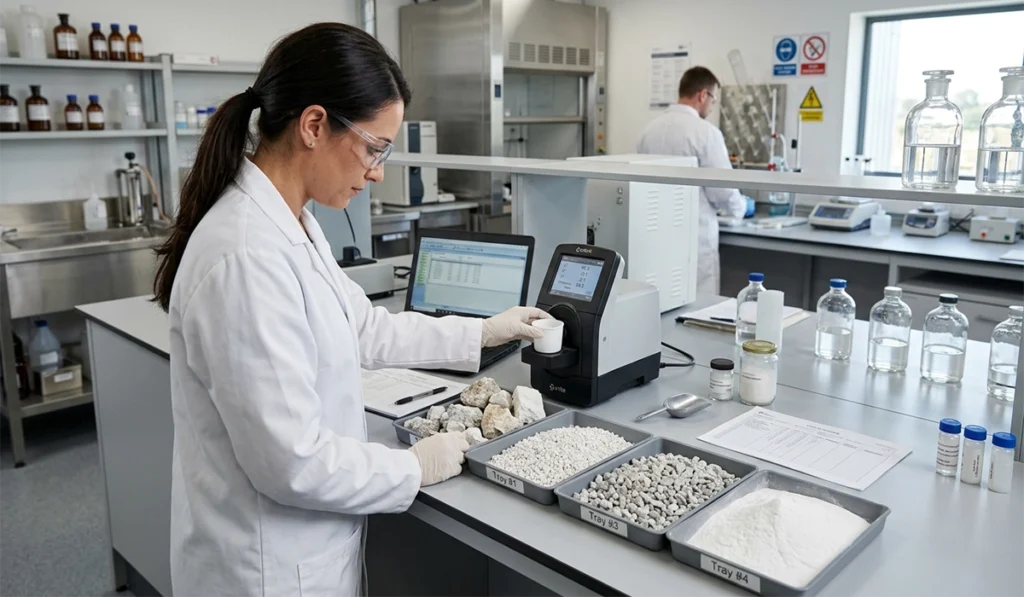
Beyond chemical purity, gypsum is segmented by grade, and grading conventions differ by destination market. There is no single global standard, so the contract must define the grading basis explicitly.
For visual and plaster applications, the whiteness index becomes critical. Whiteness is measured on a reflectance scale, and premium grades often exceed 80 on standard whiteness meters.
Iron oxide and clay inclusions are the usual culprits behind low whiteness. Even at high sulfate purity, a rock can be commercially downgraded purely on color if the end use is decorative plaster.
This is where product selection matters. A buyer needing high-whiteness material for finishing applications should reference our Satin Gypsum line, while bulk industrial users often specify Raw Gypsum Stone where color tolerance is wider.
A Note on Grade-to-Product Mapping
Different processed products demand different feedstock grades. Our Betogips Gypsum requires consistent dihydrate purity for predictable setting behavior, whereas Micronized Gypsum prioritizes particle fineness after milling.
Aligning the raw rock grade to the intended downstream product prevents over-paying for purity you do not need. It also prevents under-specifying for premium applications.
The practical rule: specify the grade by end-use requirement, not by the highest available number. Paying for 95% purity when 88% performs identically in your process is wasted margin.
Physical Sizing and Lump Specifications
Chemistry alone does not close a gypsum deal. Physical sizing is a core part of gypsum rock export specifications and is frequently the cause of rejected shipments.
Lump gypsum is commonly traded in size bands such as 0–50 mm, 50–150 mm, or 100–300 mm. The correct band depends on the buyer’s crushing and feeding equipment. Oversized lumps jam primary crushers; excessive fines disrupt kiln airflow.
Specifications should state both the nominal size range and the acceptable percentage of fines. A typical clause might cap fines below 10 mm at no more than 10% of the load.
The Fines Problem in Bulk Trade
Fines accumulate during handling, loading, and transit, even when the rock is correctly sized at the quarry. Buyers should understand that the fines percentage at discharge will differ from the percentage at loading.
This gap is a frequent source of disputes. A well-drafted contract specifies where and when sizing compliance is measured—at the quarry, at the loading port, or at discharge.
The most defensible approach is loading-port inspection by an independent surveyor. It fixes responsibility at a verifiable transfer point.
Moisture, Impurities, and Contamination Limits

Free moisture is a deceptively important parameter. Surface moisture adds dead weight, raises freight cost per ton of usable gypsum, and promotes caking during transit.
Export specifications usually cap free moisture between 1% and 4%, depending on climate and storage conditions. This is distinct from the chemically bound water in the dihydrate structure, which cannot be removed without calcination.
Impurity limits address what is not gypsum. The critical contaminants are:
- Chlorides, which corrode equipment and harm cement performance
- Magnesium salts, which interfere with set behavior
- Silica and clay, which reduce purity and whiteness
- Carbonates such as limestone or dolomite inclusions
Each of these should carry a stated maximum in the specification sheet. A purity figure that ignores contaminant ceilings tells only half the story.
Why Chlorides Deserve Special Attention
For cement and plaster producers, chloride content is often the deal-breaker. Excess chloride accelerates corrosion in reinforced structures and is tightly regulated in many construction markets.
Reputable specifications cap chlorides at low fractions of a percent, frequently below 0.1%. This figure should appear explicitly, not be buried under a generic “impurities” line.
Buyers serving regulated construction markets should treat the chloride certificate as mandatory documentation, not an optional extra.
Documentation, Testing, and Compliance
A specification is only as reliable as the documentation behind it. For cross-border gypsum trade, the paper trail is as important as the rock itself.
Standard documentation includes a certificate of analysis, certificate of origin, and an independent inspection report. The certificate of analysis must tie each parameter—purity, moisture, sizing, contaminants—to a named test method.
Pre-shipment inspection by a recognized surveyor protects both parties. The surveyor samples the actual cargo and issues findings against the contracted gypsum rock export specifications.
Sampling Methodology Matters
A certificate is meaningless if the sample was not representative. Bulk gypsum stockpiles are heterogeneous, and a single grab sample can misrepresent the entire lot.
Proper practice uses composite sampling drawn from multiple points across the stockpile or during loading. The sampling protocol should be referenced in the contract.
Buyers who skip this step inherit the risk of a non-representative certificate. The cost of independent sampling is trivial against the value of a full vessel.
Logistics: Packaging and Bulk Loading
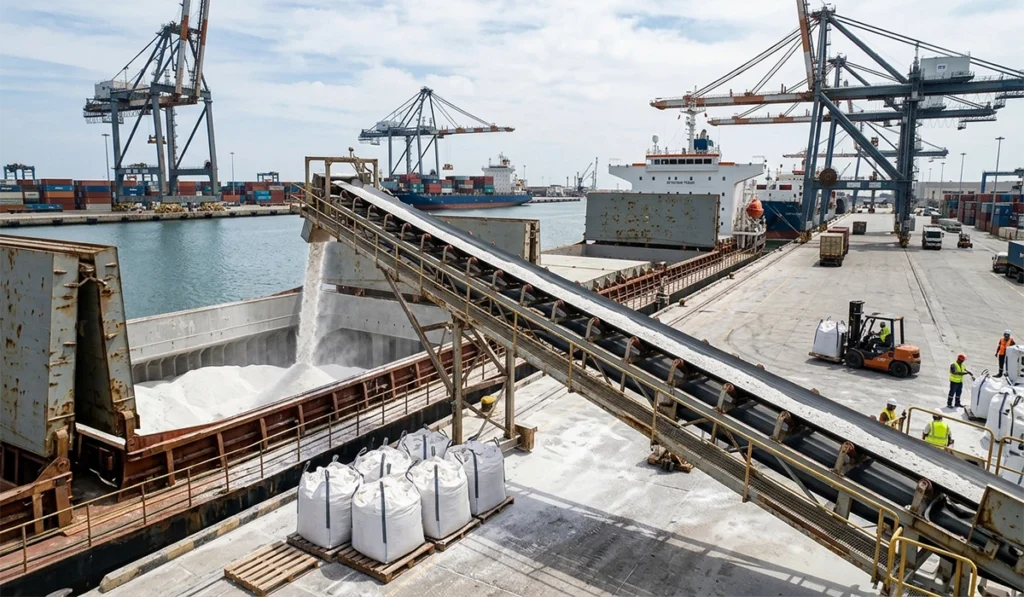
How gypsum is packaged shapes both cost and quality on arrival. The two dominant formats are bulk loose and jumbo bags, each with distinct trade-offs.
Bulk loose loading suits large-volume buyers with mechanical discharge capacity. It minimizes packaging cost but exposes the cargo to moisture pickup and contamination during handling.
Jumbo bags—typically one to one-and-a-half tons—protect against moisture and segregation. They cost more per ton but reduce losses for buyers without bulk handling infrastructure.
Matching Format to Destination
The right format depends on port facilities and inland transport at the destination. A buyer discharging at a modern bulk terminal has no reason to pay for bagging.
Conversely, a buyer relying on container shipment and manual handling benefits from bagged product. The specification should fix the packaging format and the bag standard if applicable.
Loading rate and vessel type also belong in the contract. Demurrage disputes often trace back to vague loading-rate clauses.
Sourcing the Right Grade for Your Application
Pulling these threads together, sourcing against proper gypsum rock export specifications is a process of matching parameters to end use—not chasing a single headline number.
A cement producer prioritizes dihydrate purity and chloride limits. A plasterboard manufacturer weighs whiteness and calcination behavior. A wallboard finishing operation may step up to processed grades entirely.
This is why we map raw feedstock to downstream products. Buyers refining material for premium finishes often graduate from Raw Gypsum Stone to value-added lines, and we advise on that transition during sample evaluation.
The Specification Checklist
Before committing to a gypsum supplier, your specification sheet should answer every one of the following:
- Dihydrate purity percentage and the test method
- Whiteness index, if relevant to end use
- Size range and maximum fines percentage
- Free moisture ceiling
- Chloride, magnesium, silica, and carbonate limits
- Point of compliance measurement
- Packaging format and loading terms
Any supplier unwilling to commit to these in writing is a sourcing risk. The strongest gypsum rock export specifications are explicit, testable, and tied to independent verification.
Closing Recommendation
The discipline of writing complete gypsum rock export specifications protects margin, equipment, and downstream product quality. It converts an ambiguous commodity into a controlled input.
Request a graded sample and a full certificate of analysis before any bulk commitment. Rezvan Mines supplies documented, inspection-ready gypsum against the parameters outlined here—contact our export desk to align a grade to your application.