
Buyers who check the test method and the lot number before the price avoid most supplier disputes. The evidence sits in the document, not the sample. A gypsum powder specification is only as good as the methods behind it, and many published sheets omit them entirely.
This guide is a checklist you can run against a real document. It covers what a specification tells you and what it hides. It sets out the chemical and physical parameters that decide quality, which standard to ask for, and how to verify a supplier. Knowing how to read a gypsum technical data sheet is the difference between buying material and buying a promise.
What a Gypsum Specification Tells You — and What It Hides
Buyers who ask which document they are holding avoid comparing two things that were never comparable. Suppliers issue two different papers, and the difference between a TDS and a COA decides how much weight a number carries.
A gypsum powder specification describes what a product is designed to do. It does not confirm what arrived in your container. That distinction is the single most useful thing on this page, and most specification sheets are written in a way that blurs it.
The gap is usually deliberate rather than dishonest. A producer publishes a product sheet once, then issues a gypsum test report per batch. Trouble starts when a buyer treats the first document as though it were the second.
TDS vs COA: two documents, two jobs
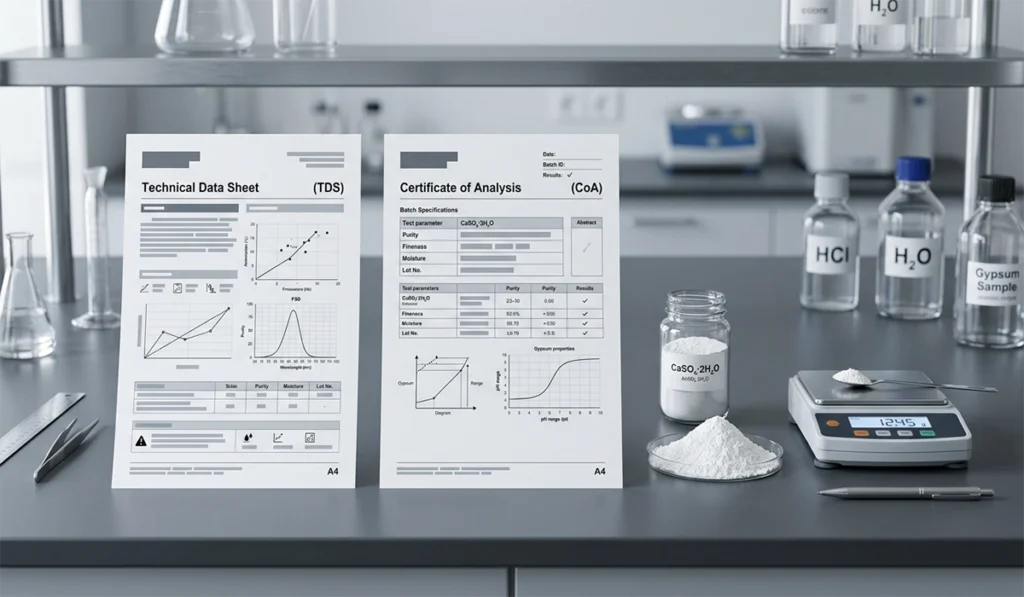
A technical data sheet (TDS) is a product description. It states the characteristics the product is designed to meet, and it applies to the product line rather than to any shipment.
A gypsum certificate of analysis (COA) is a test record. It reports measured results from a specific production lot. Only the COA tells you about the material you are buying.
Ask for both. A gypsum technical data sheet without a COA is a brochure. A COA without a TDS gives you numbers with nothing to compare them against.
“Typical value” vs guaranteed minimum
Buyers who require a guaranteed minimum with a tolerance band avoid the disputes that “typical” language is designed to survive.
A typical value is an average the producer has seen. It carries no commitment. A declared value with a tolerance band is a contractual promise: the producer states the figure and the permitted deviation either side.
Suppliers do publish flattering typical values with no tolerance band. It is normal practice, and it is not fraud — but it means a shipment that misses the number has broken nothing. Require guaranteed minimums with a stated tolerance band on every parameter that matters to your application.
The Chemical Parameters That Decide Quality
Buyers who read combined water alongside purity catch over-calcination that a headline assay conceals.
ASTM C471M covers the chemical analysis of gypsum and gypsum products in SI units. It is the reference to name when requesting a gypsum purity test, because a purity figure without a method is not a result.
What is a good purity percentage for gypsum powder? The honest answer is that it depends on the product class and the standard you buy to. Any supplier quoting a universal minimum is guessing. Ask instead what the figure controls: purity drives strength and yield, so a lower assay means more material for the same coverage. Our raw gypsum stone is analysed at source before processing.
Purity, loss on ignition and combined water
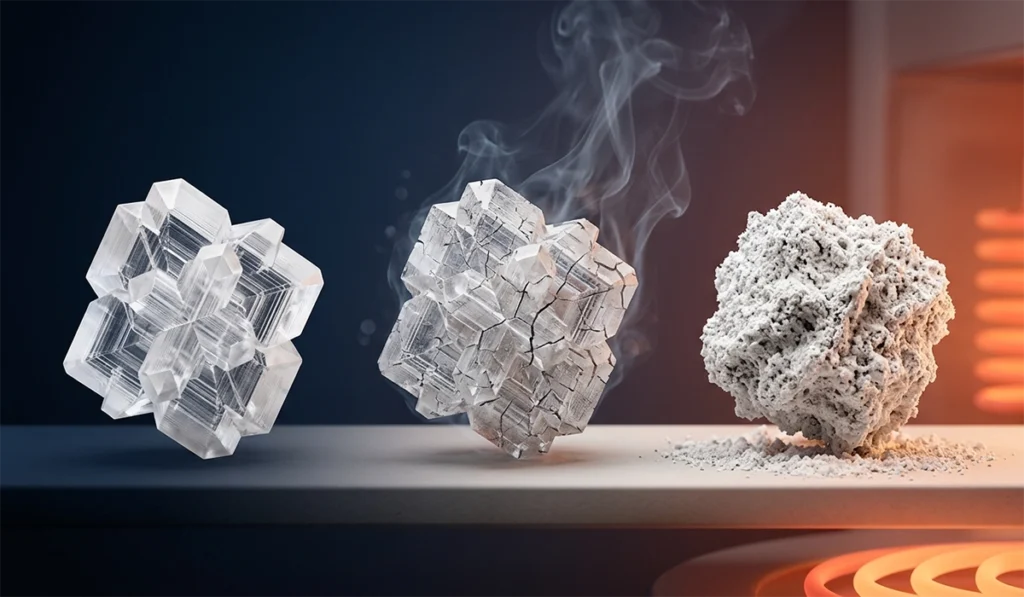
What does loss on ignition mean in gypsum? Loss on ignition (LOI) is the weight a sample loses when heated to a set temperature. In gypsum it measures the water chemically bound in the crystal.
That matters because gypsum exists in several hydration states. Dihydrate (CaSO₄·2H₂O) holds two water molecules. Hemihydrate (CaSO₄·½H₂O) holds half of one, and anhydrite holds none. Calcination drives water off deliberately.
Combined water tells you whether calcination was controlled. Too little and the powder is under-calcined. Too much and excess anhydrite forms, which is a common cause of weak plaster.
Soluble salts and chlorides — the delayed failure
Buyers who add chloride and soluble salt limits to the purchase specification avoid failures that appear long after acceptance.
Soluble salts do not show up on arrival. They migrate to the surface as the plaster dries and crystallise there — efflorescence, visible as white bloom. Chlorides go further: they attack metal, so corrosion and paint failure follow months later over fasteners and framing.
Neither parameter appears on most specification sheets unless the buyer asks. Add chloride and soluble salt limits to the purchase specification whenever metal is present in the finished system.
The Physical Parameters That Decide Performance
Buyers who pair every physical result with its test conditions avoid specifications that cannot be reproduced.
ASTM C472 covers physical testing of gypsum and gypsum plasters. It includes free water, fineness, normal consistency, setting time, compressive strength and density — the gypsum powder quality parameters that determine site behaviour.
Chemistry decides what the material is. Physics decides how it behaves in a bucket and on a wall. A buyer who checks only the chemical page is reading half the document. Finer products such as micronized gypsum are judged largely on the physical set.
Setting time: initial set vs final set
How is gypsum setting time measured? With a Vicat apparatus — a weighted needle lowered into a paste mixed to normal consistency at defined intervals.
Initial set is when the paste stops being workable. Final set is when it has hardened. Both are reported, and they answer different questions: initial set governs working time, final set governs when the next operation can start.
Conditions decide the number. EN 13279-2 specifies laboratory conditions of 23 ± 2 °C and 50 ± 5 % relative humidity. A gypsum setting time test result without a stated temperature is meaningless, and a Gulf site at 45 °C will not reproduce it.
Fineness and particle size distribution
Buyers who ask for the full particle size distribution avoid workability surprises a single sieve figure hides.
A gypsum fineness test reports sieve residue: the percentage retained on a stated mesh size. It is quick and useful, but it is one point on a curve.
Particle size distribution describes the whole curve. Two powders with identical residue on the same sieve can differ in water demand, workability, and finish quality. Ask which mesh was used, because a residue figure without a mesh size states nothing.
Strength and surface hardness
Why does gypsum plaster fail a strength test? Usually because of calcination or water ratio, not because the gypsum was impure.
EN 13279-1 requirements cover setting behaviour, flexural and compressive strength, surface hardness, and adhesive strength, alongside a declared initial setting time. Gypsum plaster compressive strength is the figure most often quoted, and the one most often quoted without conditions.
Strength results depend on the water-to-plaster ratio used in the test. Mix wetter on site than in the lab and the wall will be weaker than the certificate suggests. Always check which ratio was applied.
Whiteness and Colour: What the Number Actually Means
Buyers who agree the measurement method in writing avoid whiteness disputes that no retest can settle.
A gypsum whiteness value is an instrument reading, not a description. It is usually reported as a whiteness index, or as L*a*b* colour values. There, L* is lightness while a* and b* describe colour direction.
The problem is comparability. Different instruments, geometries, and illuminants produce different numbers from the same powder. A whiteness figure with no stated method cannot be checked against a competitor’s figure, and cannot be enforced in a dispute.
Whiteness also matters more for some products than others. For finishing plaster (white gypsum) it is a primary selection criterion. For a base coat under paint, it is close to irrelevant. Agree the method and the reference standard before it becomes an argument.
ASTM, EN and IS: Which Standard to Ask For
Buyers who name the standard in the purchase order receive comparable results from every supplier they approach.
A gypsum plaster specification means different things under different systems. ASTM dominates the US and much of the Gulf. EN 13279 applies across the EU and UK. India uses IS 2547 and IS 1290.
EN 13279-1 defines gypsum binders and plasters and classifies them into designations A for binders, B for building plasters, and C for special plasters. It also sets a useful compliance shortcut: products with less than 1% organic content are classified reaction-to-fire A1 without further testing.
| Parameter | Why the buyer cares | ASTM method | EN method | IS method |
| Chemical composition / purity | Determines strength and yield | ASTM C471M | EN 13279-2 | IS 1290 / IS 2547 |
| Free water & combined water | Signals over- or under-calcination | ASTM C472 | EN 13279-2 | — |
| Fineness | Affects workability and finish | ASTM C472 | EN 13279-2 | — |
| Normal consistency | Sets the correct water ratio | ASTM C472 | EN 13279-2 | — |
| Setting time (initial / final) | Governs working time on site | ASTM C472 | EN 13279-2 | — |
| Compressive strength | Durability of the finished surface | ASTM C472 | EN 13279-2 | — |
| Flexural strength, surface hardness, adhesive strength | Resistance to cracking and impact | — | EN 13279-1 requirements | — |
| Density | Yield per bag, transport weight | ASTM C472 | EN 13279-2 | — |
| Reaction to fire | Compliance in regulated buildings | — | EN 13279-1 (A1 if organic content < 1%) | — |
Dashes mark cells we could not verify against a named standard. Ask your supplier to fill them, and treat choosing the right gypsum product as a separate decision from choosing the standard.
Where Specifications Go Wrong
Knowing how to verify a gypsum supplier test report removes most of the failures below before a container is loaded.
Delivered material differs from the sample. The COA came from a different production lot. Require the lot number and the sampling protocol on every certificate.
Setting time on site is nothing like the spec. Test conditions were never stated, and the site is far hotter than the lab. Ask for test temperature and humidity.
Plaster is weak after drying. Over-calcination or excess anhydrite. Check combined water and LOI, not only the headline purity.
Efflorescence and paint failure appear months later. Soluble salts and chlorides were never tested. Add both to the specification.
Whiteness looks different from the sample. It was measured on another instrument or geometry. Agree the method in writing.
Material arrives caked in the bag. Free moisture too high, or packaging not moisture-proof. Set a free-moisture limit and specify the bag type — our guide to bulk shipping and packaging covers the options.
The spec looks excellent but nothing is guaranteed. Every value is labelled typical. Require guaranteed minimums.
Documents look official but are re-issued. You are buying from a trader, not a producer. Ask for the mill certificate on the producer’s own letterhead.
How to Verify a Supplier Before You Ship
Buyers who request the sampling protocol receive better material than buyers who request only a certificate — the question signals scrutiny before the batch is selected.
Can you trust a supplier’s own test report? Partly. An in-house lab result from a real producer is useful evidence. It is not independent, and it should not be the only thing you rely on for a first order.
Five steps close the gap. Ask for the current COA with the lot number and sampling protocol named. Confirm the test method and conditions for every figure. Reject any certificate that states a result without naming the test method and the sampling lot. Then request a pre-shipment inspection through a body such as SGS, Intertek, or Bureau Veritas. Independent third-party inspection gypsum buyers commission at load port is the strongest verification available. And ask for a free sample from current production before the first order.
A gypsum powder specification for export should also state packaging, free moisture, and the conditions the material will meet in transit. Rezvan Mines operates its own production in the Semnan region, with batch-level gypsum quality control and third-party inspection available on request. You can request a sample and full test report, and separately work out how much material you need.
Conclusion
A gypsum powder specification is only evidence when it names the method, the conditions, and the lot. Everything else on the page is description.
Check three things before you commit. Is this a TDS or a COA? Is every number paired with a test method and its conditions? Are the values guaranteed minimums or typical figures with no commitment behind them?
Suppliers who answer those questions without hesitation are usually producers. Request a sample and full test report and compare what comes back.
FAQ
What purity should gypsum powder be?
It depends on the product class and the standard you are buying to, so treat any universal figure with caution. Ask what the assay controls instead: purity drives strength and yield. Then require the figure as a guaranteed minimum with a named test method.
What is loss on ignition in gypsum?
Loss on ignition (LOI) is the weight a sample loses when heated to a set temperature. In gypsum it largely measures chemically combined water. Read it alongside purity, because it reveals whether calcination was controlled or whether excess anhydrite has formed.
How do you test gypsum setting time?
With a Vicat apparatus. A weighted needle is lowered into a paste mixed to normal consistency, and penetration is recorded over time. Initial set marks the end of workability, final set the point of hardening. EN 13279-2 specifies 23 ± 2 °C and 50 ± 5 % humidity.
Can I trust a supplier’s own test report?
It is useful evidence but not independent. For a first order, pair it with a third-party pre-shipment inspection through a body such as SGS, Intertek or Bureau Veritas. Also ask for the sampling protocol, since a certificate is only as representative as the sample behind it.
What is the difference between a TDS and a COA?
A technical data sheet describes what the product line is designed to achieve. A certificate of analysis reports measured results from one specific production lot. Only the COA tells you about the material you are actually buying. Ask for both documents together.
Which standard should I ask my supplier to test against?
Match it to your market. ASTM applies in the US and much of the Gulf, EN 13279 across the EU and UK, and IS 2547 or IS 1290 in India. Name the standard in the purchase order so results from different suppliers stay comparable.