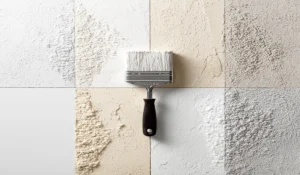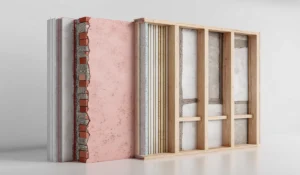

Can gypsum plaster be used in a bathroom? Yes in some parts of it, and no in others. Gypsum plaster in bathroom ceilings and on walls away from direct water is normal, accepted practice. Inside a shower enclosure it is the wrong material, and no coating changes that. Is gypsum plaster waterproof? No. It never has been.
That is the answer. The rest of this article explains where the line falls and why.
Most people ask the wrong question. They ask whether plaster is waterproof. Plaster is never the waterproofing in a wet area — it is the substrate underneath it. Once you see that, the whole subject becomes simple. This guide splits “wet” into three different exposures, because a ventilated ceiling and a shower wall are not the same problem. It then explains what the label words mean, what to use instead, and what to ask a supplier.
The Short Answer, and Why
The European plaster standard draws this line before any supplier does. EN 13279-1 covers gypsum building plasters for walls and ceilings inside buildings, and its scope explicitly includes gypsum mortar for internal partitions not exposed to water. The standard that governs the product already scopes it away from water contact.
So the real question about gypsum plaster in bathroom work is which surface, not which room. A bathroom is not one environment. The ceiling only ever meets warm damp air. A wall two metres from the shower gets splashed occasionally. The shower wall itself is soaked several times a day. Those are three exposures with three different correct answers.
Does any grade or formulation change that? No. Additives can reduce how fast the surface takes up water. They do not stop water passing through, and they do not stop the material dissolving once water reaches it. A water-repellent grade is a slower version of the same material, not a different material.
This is why the honest answer helps you more than a sales answer would. Used on the right surfaces, gypsum gives a fast, smooth, hard finish that cement render cannot match. Used in a shower, it fails, and it takes the tiles with it. A product sold into the wrong zone produces a complaint, not a repeat customer. Knowing where gypsum plaster performs best is the same knowledge as knowing where it does not.
Gypsum is soluble — that is the whole reason
Every limitation in this article comes from one property. Set gypsum plaster is calcium sulphate dihydrate, and calcium sulphate dihydrate is slightly soluble in water. Cement is not. That one difference explains everything that follows, including why gypsum is unsuitable for outdoor construction.
So what happens if gypsum plaster gets wet? Water begins to dissolve the crystal structure that gives the plaster its strength. Published research reports that the strength of moistened gypsum falls by about one third compared with dry material, and the surface loses its natural hardness. Dry it out and much of that strength returns. That single wetting is largely reversible. The problem starts when the wetting repeats.
What repeated wetting and drying actually does
Here is the fact that decides most bathroom outcomes, and almost no competing page states it. When gypsum-based materials go through wetting and drying cycles, their water absorption increases. In cement-based materials it gradually decreases. The difference exists precisely because gypsum is soluble: each wetting dissolves a little material and changes the microstructure.
That means damage is cumulative, not reversible. Each cycle leaves the plaster slightly more absorbent than the last, so the next wetting penetrates faster and deeper. The material is effectively ageing itself with every shower. Under continuous saturation, strength keeps falling, and the weakened state lasts longer in thick sections because they take longer to dry. Site practitioners call this “plaster rot”. Repeated small wettings do more harm than one flood.
Three Kinds of “Wet” — and Three Different Answers
Discussions of gypsum plaster wet areas usually treat “wet” as one category. That is the mistake which produces most failures. Humidity, splashing and immersion are three different exposures. Gypsum handles the first well, the second poorly, and the third not at all.
Notice that the difference is liquid water, not dampness. Water vapour does not dissolve anything. Liquid water on a surface does. So the useful question about any surface is simple: does liquid water land here, and how often? The table below is the article in one screen. Find your surface in the second column, then read across.
| Exposure | Typical location | Standard gypsum plaster? | What to do |
| Humid air and steam only | Bathroom ceiling, upper walls away from the shower, well-ventilated | Usually acceptable | Ensure real ventilation; extractor fan sized for the room |
| Occasional condensation | Poorly ventilated bathroom, cold external wall | Marginal | Fix the ventilation and the cold bridge first, not the plaster |
| Splashing | Around a basin, behind a kitchen sink, outside a shower screen | Not on its own | Use a moisture-resistant system, tiling, or a cement-based substrate |
| Direct and repeated wetting | Inside a shower enclosure, wet room floor and lower walls | No | Tanking membrane plus a suitable board or cement render |
| Continuous saturation | Below-ground, leaking areas, external | No | Gypsum is not the material for this |
Humid air and steam
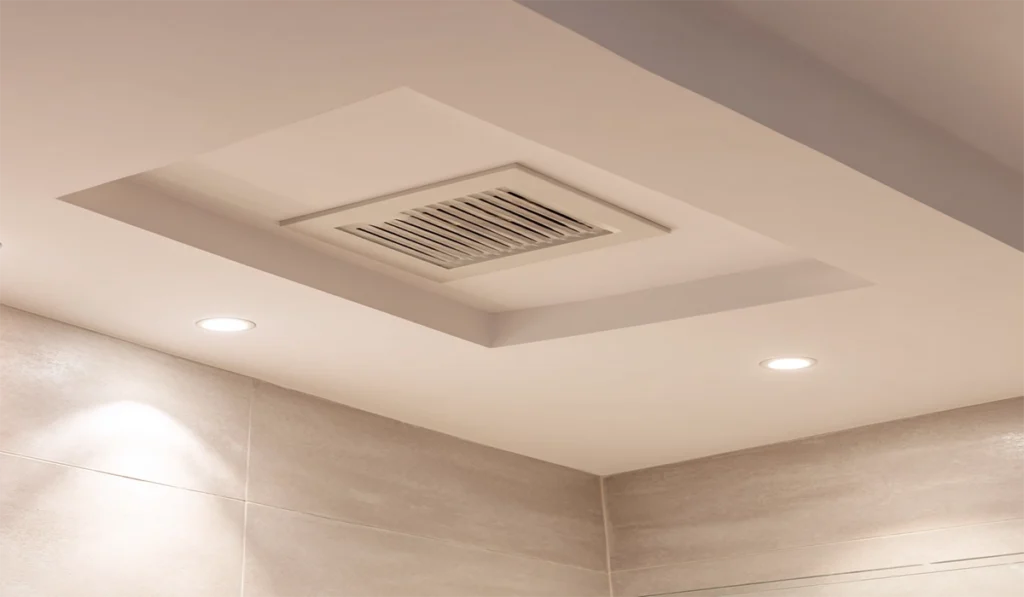
Warm damp air alone does not damage gypsum plaster. Water vapour is not liquid water, and gypsum plaster humidity tolerance is genuinely good. This is why a bathroom ceiling finished in gypsum can last for decades while the wall beside the shower fails within one year.
The risk is condensation, not humidity. When damp air meets a cold surface, vapour turns back into liquid water on that surface. A cold external wall or an unheated ceiling becomes a wetting surface every time someone showers. The fix is ventilation and insulation, not a different plaster. An extractor fan that actually runs long enough after use does more for a bathroom than any coating.
Splash zones
A splash zone is any surface that receives liquid water occasionally but is not soaked. Around a basin, behind a tap, or outside a shower screen are the usual examples. Standard gypsum plaster is not adequate here on its own.
Can gypsum be used in a kitchen? Mostly yes, with one exception. Kitchen walls and ceilings are generally dry, so gypsum is a good choice. The area directly behind the sink and hob is a splash area and needs tiling, a cement-based substrate, or a moisture-resistant system. Industry guidance places occasional-splash locations — powder rooms, areas next to tubs, behind base cabinetry with plumbing — within reach of moisture-resistant products, but not standard ones.
Direct and continuous wetting
This is where the answer is a flat no, with no qualifier. Can you tile over gypsum plaster in a shower? You should not. Tiles and grout are water resistant, not waterproof, and water moves through grout joints over time. When it reaches gypsum behind the tiles, the plaster softens, loses adhesion, and the tiles come away as a sheet.
What is the best plaster for a wet room? Strictly, none — a wet room is not a plastering problem. It needs a waterproofing system over a non-soluble substrate, usually a cement-based board or render. Wet room plaster is the wrong search; wet room waterproofing is the right one.
What “Moisture Resistant” Actually Means on a Label
These four words are used interchangeably in marketing and mean four different things. Learning the difference protects you from most bad purchases.
- Waterproof — water cannot pass through at all.
- Water resistant — resists water for a limited time or exposure.
- Water repellent — the surface sheds water, but the body of the material is not protected.
- Moisture resistant — reduced water absorption, usually measured by a defined test. It is not a guarantee of any of the above.
Moisture resistant gypsum plaster sits in the fourth category. So does almost everything sold as water resistant plaster. A water-repellent additive, often a siloxane-based hydrophobic treatment, reduces how quickly the surface takes up water. The core is still calcium sulphate dihydrate. Water that gets past the treated surface behaves exactly as it would in an untreated product.
Boards show what a real test looks like. EN 520 defines plasterboard Types H1, H2 and H3 with reduced water absorption. Under that standard, the surface water absorption of a Type H board must not exceed 180 g/m² on either face when tested by the specified method. Note carefully: EN 520 covers boards, not plasters. Board classes are useful as an illustration of how absorption is measured, but they are not evidence about any plaster.
So treat a “moisture resistant” claim as a question, not an answer. Ask for the declared water absorption figure and the test method behind it. Ask whether the manufacturer rates the product for splash exposure specifically. A number with a named test is worth something; an adjective is worth nothing. If you are comparing products, check the declared water absorption rather than the marketing description.
The Alternatives, and When to Use Each
Gypsum plaster vs cement plaster for bathrooms is the comparison most readers actually want. In one line: cement is not soluble, so it tolerates wetting that gypsum cannot, at the cost of a slower, coarser, less smooth finish. For the full picture on both materials, see how gypsum and cement compare overall.
| Option | Where it belongs | Strengths | Limits |
| Standard gypsum plaster | Dry rooms, bathroom ceilings, humid-but-ventilated areas | Smooth finish, fast, easy to apply | Not for splashing or continuous wetting |
| Water-repellent gypsum plaster | Humid areas, mild splash exposure | Reduced surface absorption | Repellent is not waterproof |
| Moisture-resistant gypsum board (EN 520 Type H) | Bathroom walls behind tiles, outside the direct wet zone | Defined, tested absorption class | Still gypsum; still needs a membrane in wet zones |
| Cement render | Splash areas, wet areas, exterior | Not soluble; tolerates wetting | Slower, less smooth, needs curing |
| Tile backer / fibre cement board | Shower enclosures, wet rooms | Built for continuous wetting | Higher cost, different fixing method |
| Tanking / waterproof membrane | Any true wet zone, over any substrate | The actual waterproofing | Is a system, not a finish; needs correct detailing |
The last row is not an alternative to the others. It sits over them, and that distinction is the subject of the next section.
Reading the table by exposure: use standard gypsum for dry rooms and ventilated ceilings. Use a water-repellent grade for humid areas and mild splash. Use cement render for bathrooms where splashing is routine. Use a tile backer board with a membrane inside a shower.
The trade-offs are real, and worth stating plainly. Cement render tolerates water, but it cures slowly and finishes coarser. Getting a gypsum-quality surface from it costs extra time and labour. Tile backer boards are the correct answer inside a shower, but they cost more and fix differently from plaster. Board also changes the sequence of trades on site.
That is why the honest recommendation is usually a mixed specification, not one product. A typical bathroom uses gypsum on the ceiling and dry walls, a moisture-resistant system around the basin, and board with a membrane inside the shower. Specifying one material for the whole room is what causes the failures in the next section.
If you also need a surface filler for damp locations, see choosing a putty for damp exposure. Where you need a low-absorption substrate product, Gyptone gypsum for low-absorption substrates is worth requesting a declared figure for before you specify it.
Plaster Is Not the Waterproofing
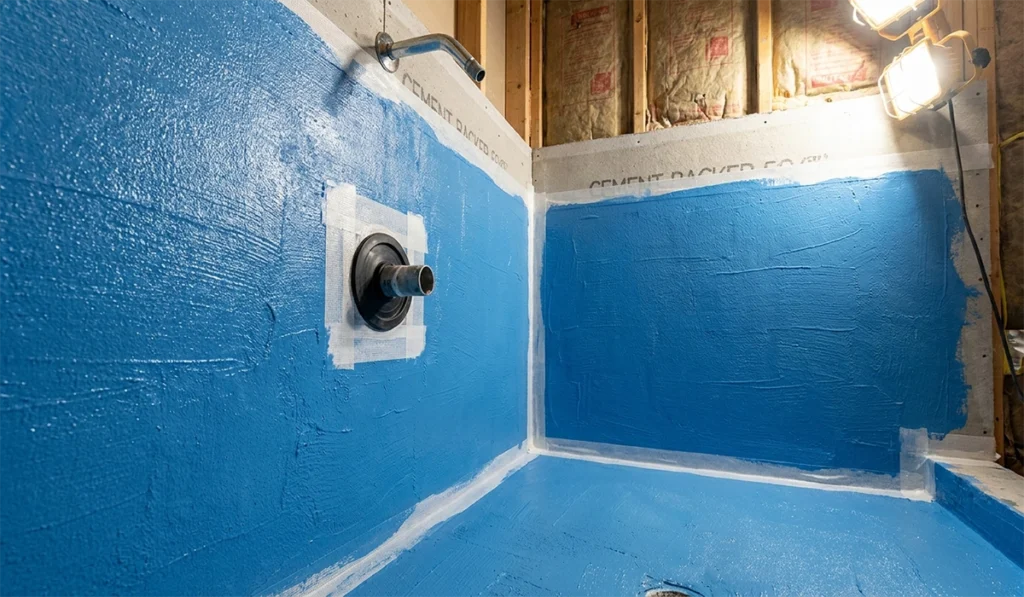
This is the single most useful idea in the article, and it corrects the question most readers arrive with. In a wet area, plaster is never the barrier. It is the substrate. The waterproofing is a separate product, applied as a system, with its own standard and its own detailing rules.
That separation is formal, not rhetorical. EN 14891 covers liquid-applied water-impermeable products used beneath ceramic tiling. Waterproofing is a defined product class, tested for water impermeability and for adhesion. A plaster is not tested that way, because it is not intended to do that job.
So how to protect gypsum plaster from moisture? In humid areas, ventilate. In splash areas, tile or change the substrate. In true wet zones, do not protect the gypsum — replace it, then waterproof over the replacement. There is no waterproof plaster for bathroom showers, and a surface treatment is not a system.
This is also where responsibility falls through the gap on site. The plasterer’s work ends at a flat surface. The waterproofing contractor’s work starts at a sound substrate. Neither owns the decision about which material belongs on which surface. When nobody owns it, the failure appears a year later, and both trades believe they did their part correctly. Naming that decision in the specification is what closes the gap.
Where Wet-Area Work Fails
Wet-area failures repeat themselves. The same eight patterns account for most complaints, and each has a root cause and a decision that prevents it. Note that half of them are not really plaster problems at all.
| Failure | Root cause | The decision that prevents it |
| Plaster softens and crumbles beside the shower | Splash exposure on a soluble material | Use a cement-based or board substrate in splash areas |
| Tiles come away in a sheet | Water reached the gypsum behind them; it lost strength and adhesion | Waterproof the substrate before tiling in wet zones |
| Black mould along the ceiling line | Condensation plus no effective ventilation | Fix ventilation first; the plaster is not the cause |
| Surface fine at first, failing after a year | Cumulative damage from repeated wet–dry cycling | Match the material to the repeated exposure, not the worst single event |
| “Waterproof” paint applied and the wall still failed | A coating is not a waterproofing system | Use a tanking membrane where water actually reaches |
| Damage worse in a thick coat than a thin one | Thick sections stay saturated far longer | Reduce exposure; do not rely on thickness |
| Efflorescence and staining through the finish | Moisture moving through and carrying salts | Address the moisture source, not the surface |
| Repair fails in the same place | Original cause never diagnosed | Find the water path before replastering |
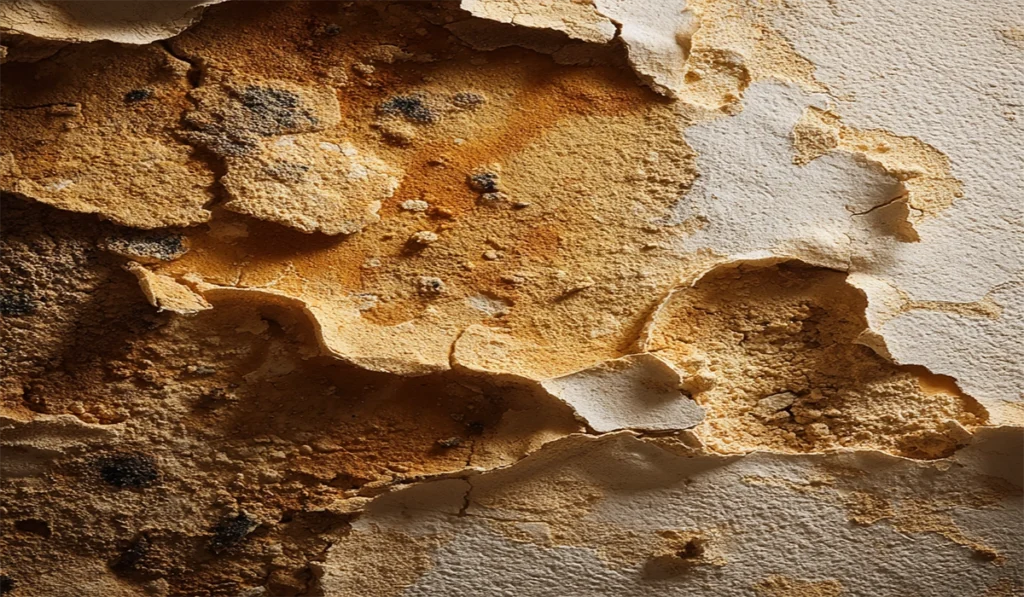
Does gypsum plaster grow mould? Not by itself — gypsum is a mineral and not food for mould. Mould grows on damp organic material, including paper facings, paint films, dust and soap residue. Industry guidance is blunt about the condition that matters: gypsum products must be kept dry to prevent mould growth. Black mould along a ceiling line is a ventilation diagnosis, not a plaster diagnosis, and replacing the plaster without fixing the air change will reproduce it.
Two more patterns are worth expanding, because both look like product faults and are not.
The “waterproof” paint failure is the most common. Someone paints a sealer over gypsum in a shower and treats the problem as solved. A coating is a surface treatment, not system waterproofing. It has no detailing at corners, junctions or penetrations, and those are exactly where water travels. The wall fails at the joints while the painted field looks perfect.
Thickness failures surprise people for the opposite reason. A thick coat feels more robust, so it seems safer in a damp area. In practice a thick section holds water longer and stays weak longer, because drying is slower through the full depth. Applying more material increases the damage rather than resisting it.
Efflorescence belongs in the same group. White crystalline staining appearing through a finish means moisture is moving through the wall and carrying dissolved salts to the surface. Cleaning the surface treats the symptom. The staining returns until the moisture path is closed.
The last row deserves attention. A repair that fails in the same spot means the water path was never found. Damp patches also have causes unrelated to bathrooms — see other causes of wall damage before assuming the finish is at fault.
What to Specify and Ask For
Before you specify gypsum plaster in bathroom work, define the exposure first and the product second. Walk the room and label each surface: humid only, splash, or true wet zone. That single step prevents most failures described above.
Then ask the supplier four questions. What is the declared water absorption, and by which test method? Is this grade rated for splash exposure, or only for humid environments? What is the recommended substrate and system behind it? And what does the technical data sheet actually say, as opposed to the brochure?
If you need moisture resistant plaster for bathroom walls, that phrase alone is not a specification. Nor is “bathroom wall plaster” on a delivery note. Either becomes one only when it carries a number and a test. A supplier who cannot give you both is telling you something useful.
Tell us the exposure — ceiling, splash area or wet room. We will tell you whether one of our products suits it, or whether you need a different material. That last outcome is a real one. You can ask which grade suits your exposure and get a technical data sheet with any quotation.
Conclusion
Gypsum plaster in bathroom projects works, on the right surfaces, for a clear physical reason. Gypsum is soluble; cement is not. Humid air does not dissolve it, splashing does so slowly, and repeated direct wetting does so permanently, because absorption rises with every wet–dry cycle instead of falling.
Two decisions follow. First, classify each surface by exposure before choosing any product, because a bathroom contains three environments and not one. Second, stop looking for a waterproof plaster. In a true wet zone the waterproofing is a separate, tested system, and the plaster or board underneath it is only the substrate. Get those two right and the finish will outlast the fittings. Get them wrong and the repair bill will exceed what the plaster ever cost.
FAQ
Is gypsum plaster waterproof?
No. Set gypsum is calcium sulphate dihydrate, which is slightly soluble in water. Water-repellent additives slow surface absorption but do not make the material waterproof. Water that passes the surface behaves as it would in an untreated product.
Can I plaster a bathroom with gypsum?
Partly. Ceilings and walls away from direct water are fine in a ventilated bathroom. Splash areas need tiling or a cement-based substrate. Inside a shower enclosure, use a suitable board or render with a waterproofing system.
What happens if gypsum plaster gets wet?
t loses strength as water dissolves the crystal structure. Research reports roughly a one-third strength reduction in moistened gypsum, with the surface losing hardness. A single wetting largely reverses on drying. Repeated wetting does not.
Can I tile over gypsum plaster in a shower?
No. Grout and tiles are water resistant, not waterproof, so water reaches the substrate over time. The gypsum then softens and loses adhesion, and tiles can detach as a sheet. Use a waterproofed, non-soluble substrate.
Does gypsum plaster cause mould?
No. Gypsum is a mineral and does not feed mould. Mould grows on damp organic material such as paper facings, paint films, dust and soap residue. Persistent condensation is the real cause, so fix ventilation first.
What should I use instead in a wet room?
A waterproofing system over a non-soluble substrate. Typically that means a tile backer board or cement render, then a liquid-applied or sheet membrane, then tiles. The membrane does the waterproofing, not the finish.
What is the difference between water resistant and waterproof?
Waterproof means water cannot pass through. Water resistant means it resists water for a limited exposure or time. Water repellent means the surface sheds water while the body stays vulnerable. Only the first is a barrier.
Can gypsum plaster be used on a bathroom ceiling?
Usually yes, in a properly ventilated room. Ceilings meet water vapour rather than liquid water, and gypsum tolerates humidity well. The exception is persistent condensation on a cold ceiling, which is an insulation and ventilation problem.