
Buyers who ask which gypsum is better usually get the wrong answer, because it is the wrong question. Both natural and by-product gypsum produce excellent material, and both produce poor material. What separates them is not quality. It is where the variation comes from, and therefore what you have to control.
This guide compares the three families a buyer will be offered. It sets out what changes in processing, and what to write into a purchase specification. It answers the question behind the natural vs synthetic gypsum debate: is synthetic gypsum as good as natural gypsum, and under what conditions? The short answer is that a well-run scrubber competes with any mined source. But the risks attached to each route differ, and so does their durability.
Three Families: Natural, FGD and Other By-Product Gypsums
Buyers who can name the source of every tonne they purchase avoid most sourcing failures — the control is knowing the route, not testing the delivery. Gypsum reaching the market comes from three distinct routes, and each carries different risks.
All three are chemically the same compound: calcium sulphate dihydrate. That shared chemistry is why any natural vs synthetic gypsum comparison starts closer than buyers expect, and why some assume the differences do not matter. They do, but not at the level of the molecule. They appear in what travels alongside it, and in whether the supply will still exist in five years.
The question of what is FGD gypsum made from comes up constantly in tenders, and it is worth answering precisely before comparing anything.
Natural (mined) gypsum
Natural gypsum is quarried or mined from a geological deposit laid down by evaporating seawater. Producers work a seam within that deposit, removing overburden to reach it.
Mined gypsum arrives as rock. It is crushed, screened, and where necessary beneficiated to remove clay, silica, or anhydrite from adjacent zones. Its purity depends on the deposit and the specific seam being worked, which is why two loads described as “natural” can differ.
The commercial consequence is reserve life. A deposit with decades of proven reserve is a different proposition from a supply tied to an operating plant. Rezvan Mines supplies raw gypsum stone from our own deposit in the Semnan mineral region.
FGD gypsum
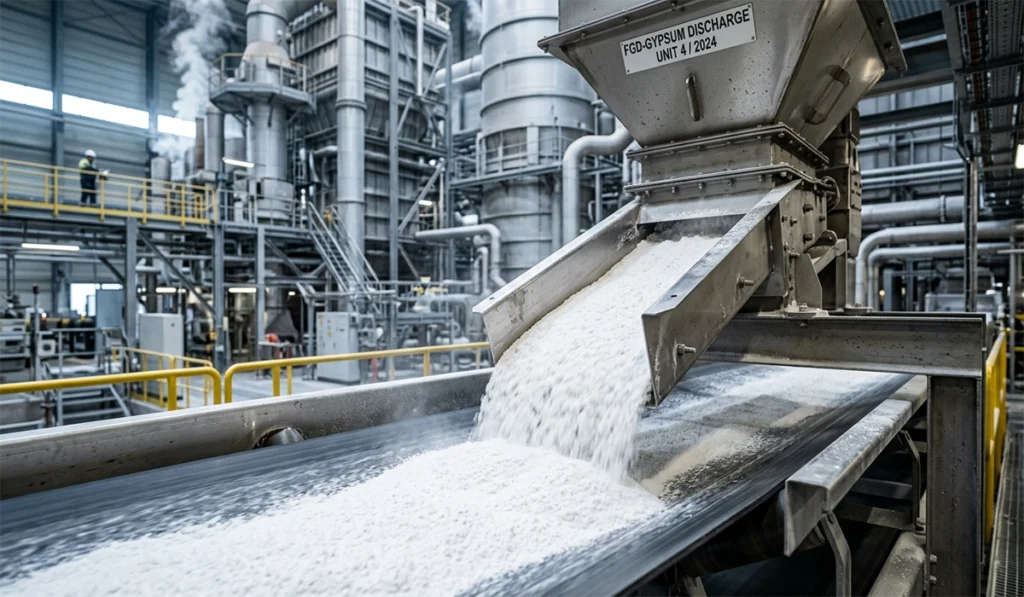
FGD stands for flue gas desulphurisation. Coal-fired power stations remove sulphur dioxide from their flue gas by passing it through a limestone or lime scrubber. The reaction produces calcium sulphate dihydrate — chemically identical to mined gypsum.
Flue gas desulfurisation gypsum, also called desulphogypsum, leaves the scrubber as a wet slurry. It is dewatered into a filter cake before sale. A well-run scrubber on consistent coal produces very high purity material with fine, uniform crystals.
Its variation comes from the process, not the ground: the coal burned, the limestone used, and how carefully the plant is operated.
Phosphogypsum and other by-product gypsums
Phosphogypsum is a by-product of phosphate fertiliser production. It is the one source where the constraint is regulatory rather than technical.
Phosphate ore contains radium-226, a naturally occurring radioactive material (NORM) that decays into radon gas. Roughly 80% of the radium-226 in the ore concentrates into the phosphogypsum. In the United States, 40 CFR 61 Subpart R requires phosphogypsum to be placed in engineered stacks. Limited exceptions cover outdoor agricultural use and indoor research.
So can phosphogypsum be used in plaster? Not in the US, and buyers elsewhere should confirm their own national position rather than assume.
Purity and Consistency: Which One Actually Wins?
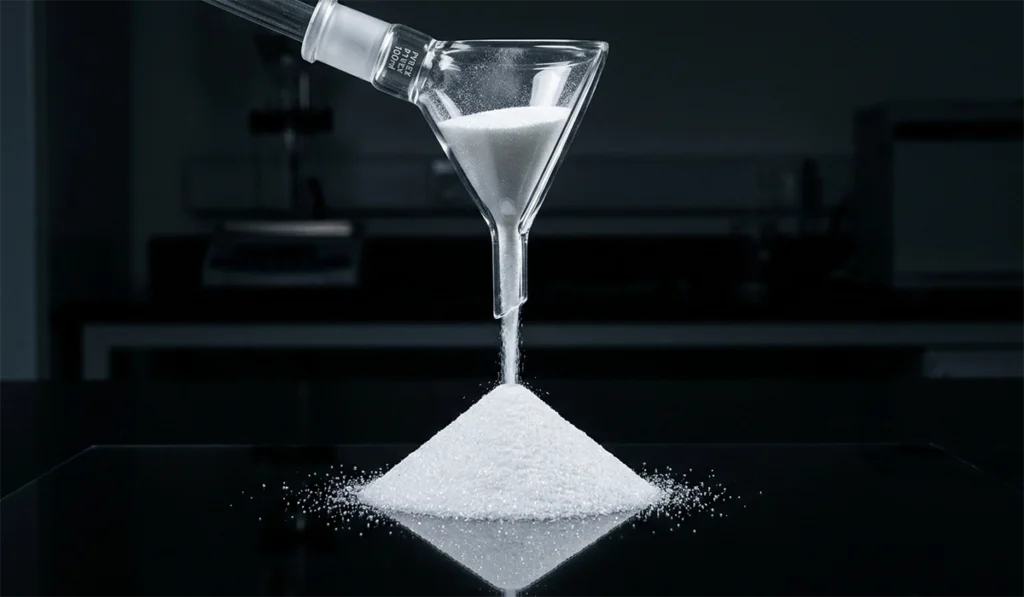
Neither source wins. That is the finding most buyers are not told, and it is the one that changes procurement decisions.
Set out the natural gypsum vs FGD gypsum question properly and the picture clarifies. A good deposit and a well-run scrubber both deliver high-purity material. A poor seam and a badly operated scrubber both deliver problems. Any honest gypsum purity comparison has to start there.
What differs is the source of variation. Natural gypsum varies geologically — with the seam, the depth, and the zone of the deposit being worked. FGD gypsum varies by process — with the coal, the limestone, and plant operation. Neither is automatically consistent. The buyer’s job is knowing which lever controls their supply, and asking for evidence of it.
| Factor | Natural (mined) gypsum | FGD gypsum | Phosphogypsum |
| Origin | Geological deposit | Power-station scrubber by-product | Phosphate fertiliser by-product |
| Typical purity | Varies by deposit and seam | Can be very high from a well-run scrubber | Varies; not the limiting issue |
| Source of variation | Geological — seam, overburden, deposit zone | Process — coal source, scrubber operation | Process and ore chemistry |
| Free moisture as received | Low | High; requires dewatering and drying | High |
| Crystal size | Coarser, variable | Fine, uniform | Fine |
| Typical contaminants of concern | Clay, silica, dolomite, anhydrite | Chlorides, mercury, fly ash carry-over, unreacted limestone | Radium-226 and other NORM |
| Regulatory constraint | Standard mining and product regulation | Standard product regulation | Restricted; stacked under 40 CFR 61 Subpart R in the US |
| Long-term availability | Tied to reserve life | Tied to coal plants remaining in operation | Large stockpiles, restricted use |
| Best-fit applications | Plaster, board, cement, agriculture | Board, cement, agriculture | Restricted; mainly agricultural where permitted |
On natural gypsum purity compared to FGD gypsum, resist ranking them. Ask instead which supplier can show the sampling protocol behind the certificate. Knowing how to read the test report behind these numbers matters more than the headline figure. The same logic applies to gypsum in cement manufacturing, where set control depends on consistency rather than peak purity.
The Differences That Show Up in Processing
Producers who re-qualify their mix design after any source change avoid the failures that follow a swap. The trigger is the source, not the supplier name.
Chemistry says the sources are interchangeable. Plant experience says otherwise, and the reason is physical rather than chemical. Synthetic gypsum quality is usually judged on purity, but purity is not what causes trouble on a production line. Moisture and crystal shape are.
This is where buyers switching source mid-project run into difficulty. The certificate matches, the assay matches, and the mix stops working. Water demand changes, setting behaviour shifts, and the formulation needs re-tuning. Anyone comparing the difference between plaster grades meets the same principle. For finer products such as micronized gypsum, the effect is more pronounced still.
Free moisture, dewatering and handling
Buyers who set a free-moisture limit in the contract avoid caking and weight disputes on arrival — the control is the specification, not the inspection.
Mined gypsum arrives dry. It comes out of the ground as rock and carries low free moisture. FGD gypsum arrives as filter cake. If it has not been properly dewatered and dried, the buyer receives problems. Material cakes in the bag or hold, weights disagree with the invoice, and discharge becomes difficult.
Specify a maximum free moisture figure and the packaging. Our guidance on bulk shipping and packaging covers the practical side.
Particle size and crystal habit
Plants that check particle size distribution before a source change avoid reformulating under production pressure — the measurement is cheap, the reformulation is not.
Crystal habit is the shape and size of the individual gypsum crystals. FGD gypsum forms fine, uniform crystals in the scrubber. Mined gypsum produces coarser, more variable crystals determined by geology and by how it was crushed.
That difference drives water demand, agglomeration behaviour, and how the material flows and packs. Two materials with identical purity can behave differently for this reason alone.
Contaminants and Compliance
Specifiers who confirm the regulatory position in the destination country avoid the rejections that origin-country compliance does not prevent.
Is FGD gypsum safe for construction? Yes — it is used in a large share of the world’s wallboard, and the question is settled in practice rather than in principle. The relevant question is which contaminants to specify against.
Does synthetic gypsum contain heavy metals? It can. Coal contains trace elements, and mercury is the one most discussed. Chlorides matter more commercially, because the problem does not appear on arrival. It surfaces months later as corrosion, or as paint failure over a fastener. Require a chloride limit in the purchase specification whenever metal is present in the finished system. Fly ash carry-over and unreacted limestone are the other carry-over items worth naming.
Mined gypsum carries different contaminants — clay, silica, dolomite, and anhydrite from adjacent geological zones. These affect purity and processing rather than long-term durability.
On phosphogypsum, the position is jurisdictional. US restrictions under Subpart R do not apply in the EU, India, or the Gulf, and each destination must be checked separately.
Supply Security: Why the Market Is Moving Back to Mined Gypsum
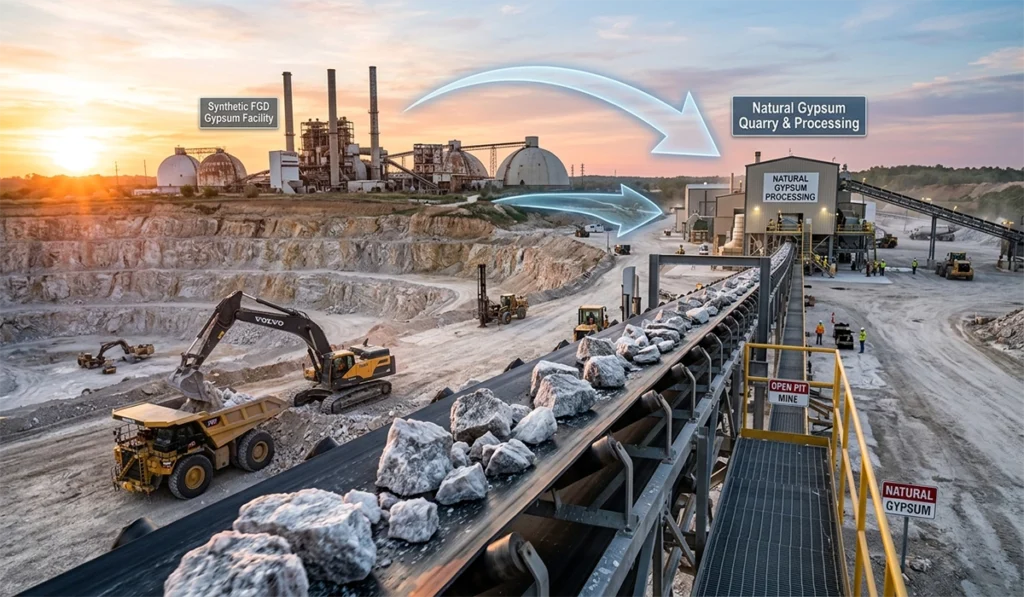
Buyers who qualify a second source before they need one avoid the short-notice gaps that follow a plant closure announcement.
Why is synthetic gypsum supply declining? Because it is a by-product of coal-fired power generation, and that generation is contracting in Europe and North America. Climate Action Network Europe has reported that half of Europe’s coal power plants have closed or pledged to close before 2030.
The logic is uncomfortable but simple. FGD gypsum exists only while the plant that produces it runs. It is not a mine with a reserve life; it is an output stream with a closure date attached. As coal generation falls, so does the volume of by-product gypsum available.
This is why natural gypsum supply has become a procurement conversation rather than a technical one. A mined deposit is tied to geological reserve rather than to an energy policy decision. Rezvan Mines has operated its deposit for over 40 years, with in-house processing and batch traceability — our deposit and production facilities set out the basis. Third-party inspection through SGS and Intertek is available on request.
Where Buyers Get This Wrong
Buyers who ask which deposit or plant a shipment came from avoid most failures below. The question costs nothing, and the answer is diagnostic.
The mix design stops working after a source change. The root cause is different crystal habit and water demand. Re-qualify the mix whenever the source changes, not only when the supplier does.
Corrosion or paint failure appears months after handover. Chlorides were never specified or tested. Put a chloride limit in the purchase specification.
Material arrives caked and overweight. The filter cake was not properly dewatered. Set a free-moisture limit and specify packaging.
Supply disappears at short notice. The buyer was sole-sourced from a plant with a closure date. Qualify a second source before you need it.
A regulator or certifier rejects the product. The by-product source is not permitted for that use in that jurisdiction. Confirm the position for the destination country.
The certificate looks excellent but the delivery does not match. The sample was not representative of the seam or the batch. Require the sampling protocol and lot traceability.
Green-building points are refused. There is no Environmental Product Declaration (EPD) for the actual source. Ask for the EPD before specifying, not after.
“Natural” is claimed but cannot be verified. The material came from a trader with no mine of origin. This is how to tell if gypsum is natural or synthetic in commercial practice: ask which deposit, and ask for evidence.
How to Specify Your Source
Buyers who name the source route in the specification receive material they can audit — the clause does the work that inspection cannot.
Good gypsum sourcing is a specification exercise, not a testing exercise. The natural vs synthetic gypsum decision is settled in the contract clauses below, not on the laboratory bench. Six clauses cover most of it.
Name the source route — mined, FGD, or other by-product — and the specific deposit or plant. Set a purity requirement with the test method referenced. Set a free-moisture maximum. Set a chloride limit wherever metal is present in the finished system. Require the sampling protocol and lot traceability behind every certificate. And require the EPD if the project is pursuing LEED or BREEAM credits.
On which gypsum is better for cement production, the answer follows the same logic: specify consistency and set control behaviour, then let suppliers demonstrate compliance. If your current gypsum raw material is tied to a plant with a closure date, qualify a mined alternative now rather than under pressure. You can request a sample and source documentation to begin that qualification.
Conclusion
The natural vs synthetic gypsum comparison does not resolve into a winner. Both routes produce material that performs, and the difference between a good load and a poor one is larger within each source than between them.
What differs is where variation originates and how durable the supply is. Geological variation is controlled by knowing the seam. Process variation is controlled by knowing the plant. Only one of the two routes has a reserve life rather than a closure date.
FAQ
Is synthetic gypsum lower quality than natural gypsum?
No. A well-run scrubber produces high-purity material used in much of the world’s wallboard. Quality varies within each source more than between them. What differs is the origin of that variation and the security of long-term supply.
What is FGD gypsum made from?
It is made from the reaction between sulphur dioxide in power-station flue gas and a limestone or lime scrubber. The product is calcium sulphate dihydrate — the same compound as mined gypsum. It leaves the scrubber wet and requires dewatering.
Is FGD gypsum safe to use in buildings?
Yes, and it is widely used in board and cement. The practical concerns are chlorides, mercury, and fly ash carry-over rather than safety in principle. Specify limits for the contaminants relevant to your application and require test evidence.
Why is synthetic gypsum becoming harder to buy?
Because it is a by-product of coal-fired generation, which is contracting in Europe and North America. Climate Action Network Europe reports that half of Europe’s coal plants have closed or pledged to close before 2030. Volume falls with the plants.
Can I tell natural and synthetic gypsum apart in the lab?
Crystal habit and particle size distribution differ noticeably, and trace contaminants point to origin. But laboratory work is slower than asking the supplier which deposit or plant the material came from, and requiring documentary evidence of it.
Which source should I specify for cement?
Specify consistency and set control behaviour rather than a source. Both mined and FGD gypsum are used in cement. The deciding factors are usually batch-to-batch stability, free moisture on arrival, and whether the supply will still exist in five years.