
What is the HS code for gypsum powder? Most gypsum products sit in heading 2520, and the answer usually turns on one question: is the material calcined or not.
That heading is where this guide starts. But the gypsum HS code question is rarely the whole problem. Additive-rich products such as putty powder and joint filler may not belong in Chapter 25 at all, and that is where reclassification disputes begin.
One thing to state plainly before anything else. Classification is the importer’s legal responsibility in most countries, not the exporter’s. This guide is not customs advice. It explains the headings, the criteria that separate them, and the mechanism for getting a binding answer for your own shipment.
Below: the codes, the full document set, conformity programmes, and where shipments actually get held.
The Gypsum HS Codes You Need to Know
The Harmonized System is maintained by the World Customs Organization (WCO). Its first six digits are common worldwide. Individual countries then add more digits. The EU uses an eight-digit Combined Nomenclature (CN) and a ten-digit TARIC code. The US uses a ten-digit HTS code, and India an eight-digit ITC-HS code, sometimes called the HSN code for gypsum and other goods.
So a gypsum HS code quoted at six digits is only the international part of the answer. Your destination’s full code will be longer.
Chapter 25 is “Salt; sulphur; earths and stone; plastering materials, lime and cement.” HS 2520 sits within it. The heading reads: “Gypsum; anhydrite; plasters (consisting of calcined gypsum or calcium sulphate) whether or not coloured, with or without small quantities of accelerators or retarders.”
Read that wording carefully. The phrase “small quantities of accelerators or retarders” is the hinge of the whole classification question, and Section 1b explains why.
The HS code for gypsum powder therefore depends on what the powder actually is. Raw ground stone, calcined building plaster and a polymer-rich surfacing compound are three different products, even when all three arrive as a white powder in a 25 kg bag.
Two other headings sit nearby and catch people out. Heading 6809 covers articles of plaster and compositions based on plaster, which is where boards and blocks belong rather than in Chapter 25. And EU rules-of-origin material notes an exception within heading 2520 for plasters specially prepared for dentistry.
Use the table below as a starting point for a conversation with your broker, not as a declaration.
| Product | Likely heading | Notes |
| Raw gypsum stone, uncalcined | 2520.10 | Gypsum; anhydrite |
| Calcined gypsum plaster / building plaster | 2520.20 | Plasters, with only small quantities of accelerators or retarders |
| Finishing plaster (white gypsum) | 2520.20 | Same heading, subject to composition |
| Micronized gypsum | 2520.10 or 2520.20 | Depends on whether it is calcined |
| Putty powder, joint filler, jointing compound | 2520.20 or 3214 — verify | Depends on composition and intended use |
| Gypsum boards, blocks, plaster articles | 6809 | Articles of plaster |
| Dental plasters | Excluded from parts of 2520 | Specially prepared for dentistry |
National codes extend beyond six digits and differ by country — always confirm the full code with the destination authority.
2520.10 vs 2520.20: raw stone or calcined plaster
The difference between HS code 2520.10 and 2520.20 is calcination, not fineness. Subheading 2520.10 covers gypsum and anhydrite. Subheading 2520.20 covers plasters.
So raw gypsum stone, crushed or ground but never heated, sits at 2520.10. Grinding it finer does not move it. What moves it is calcination — driving off part of the chemically bound water to produce calcium sulphate hemihydrate.
The gypsum plaster HS code for a calcined building plaster is therefore 2520.20. Searches for an HS code for gypsum plaster 2520 20 land here correctly, provided any additives stay within the “small quantities of accelerators or retarders” limit in the heading text.
This catches people out with micronized products. A very fine uncalcined powder is still 2520.10. The mill does not change the chemistry; the kiln does.
When your product may not sit in Chapter 25 at all
This is the section most guides skip, and the one most likely to cost money.
Is wall putty powder classified under 2520 or 3214? It is a genuine question, not a trick one. Heading 3214 reads: “Glaziers’ putty, grafting putty, resin cements, caulking compounds and other mastics; painters’ fillings; non-refractory surfacing preparations for façades, indoor walls, floors, ceilings or the like.”
The WCO Explanatory Notes to heading 3214 state that these preparations are characterised by the use to which they are put. They note that such products are usually in a more or less pasty form. Some, however, are supplied in solid or powder form and made pasty at the time of use by adding a liquid such as water. They are usually applied with a caulking gun, spatula, trowel, plasterer’s float or similar tool.
Read that against heading 2520, which covers plasters of calcined gypsum carrying only small quantities of accelerators or retarders. A gypsum-based putty powder or joint filler powder with meaningful polymer or other additive content can look like a candidate for either heading.
Three criteria separate them: what the product is made of, how much of it is something other than calcined gypsum, and what it is sold to do.
This is a real and common source of reclassification disputes. Reclassification means back-duty, penalties and delay, sometimes assessed months after the goods cleared. Chapter 25 versus Chapter 32 is the single most expensive contrast in this article.
This guide will not tell you which heading applies to your product. Nobody responsibly can, without the composition. Take it to a binding ruling and to your customs broker — Section 5 explains how.
Why Classification Is the Importer’s Risk
In most jurisdictions the importer of record carries legal responsibility for the declared code. Not the exporter, not the freight forwarder, and not the supplier who wrote a code on the invoice.
That matters more than it sounds. A supplier’s suggested code is an opinion. It may be well informed, from a producer who has shipped the product for decades. It still does not bind the customs authority at destination, and it does not protect the importer from a reassessment.
Tariff classification of gypsum is also not a one-off task. Duty, import licensing and conformity requirements all follow from the code, so an error propagates through the whole transaction.
The gap between a declared classification and customs’ own determination is where back-duty and penalties live. Customs can and does reach its own view, and it can apply that view retroactively to entries already cleared.
There is a correct answer to “which code is mine?”, and it is not a supplier’s email. It is a binding ruling from the authority that will actually clear your goods. Almost no competing article on this topic mentions that mechanism.
One practical note on Incoterms: the rule you agree determines who lodges the export declaration and who is the importer of record. That allocation of responsibility is worth settling before the first shipment, alongside what an Incoterm includes in the price.
The Document Set for a Gypsum Shipment
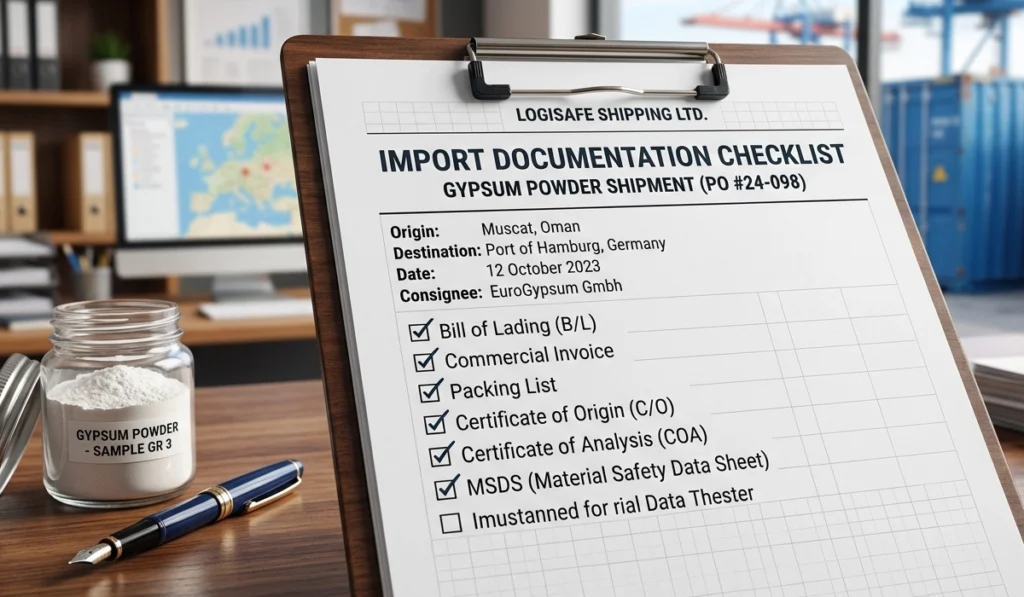
What documents are needed to import gypsum? The core set is short and predictable. Importing gypsum powder becomes difficult only when one document is missing, or when two documents disagree with each other. Gypsum customs documents rarely fail on their own; they fail against each other.
The table below is the standard set. Which of them your shipment actually needs depends on the destination, the payment method and the Incoterm.
Three of these are effectively universal. The commercial invoice, the packing list and the transport document travel with almost every shipment, everywhere. The rest are conditional, and the conditions are worth knowing before you quote rather than after you ship.
The certificate of origin is required by most destinations, though the accepted format varies. Quality documents such as the certificate of analysis are driven by the buyer and the contract rather than by customs. Conformity certificates are driven by the destination’s regulatory regime. Insurance documents follow the Incoterm: they matter under CIF and CIP and are the buyer’s own concern under FOB.
The single most useful habit is to build the document list into the contract, not to assemble it at shipment. Every item below has a lead time, and two of them — origin attestation and conformity certification — can take longer than the production itself.
One more principle underpins all of it. These documents must agree with each other. Customs and banks both compare them, and a discrepancy between two correct documents causes as much delay as one missing document.
Reference: ICC Uniform Customs and Practice for Documentary Credits (UCP 600) — the ICC rules governing how banks examine documents presented under a letter of credit.
| Document | Issued by | Usually required for | Notes |
| Commercial invoice | Exporter | Every shipment | Must match the LC wording exactly |
| Packing list | Exporter | Every shipment | Bag count, net and gross weight, pallet count |
| Bill of lading | Carrier | Sea freight | Original vs telex release — agree in advance |
| Certificate of origin | Chamber of commerce | Most destinations | Some countries require attestation or legalisation |
| Certificate of analysis | Producer or lab | Quality-sensitive buyers | Composition and test results |
| Weight certificate | Independent surveyor | Bulk and some bagged cargo | Common where payment is by weight |
| Pre-shipment inspection certificate | SGS / Intertek / BV | Countries with conformity programmes | See Section 4 |
| Insurance certificate | Insurer | CIF and CIP terms | Follows the Incoterm |
| Safety data sheet | Producer | Often requested | Gypsum is normally not regulated as dangerous goods |
For how the goods themselves travel, see how bulk gypsum is packed and shipped.
Commercial documents
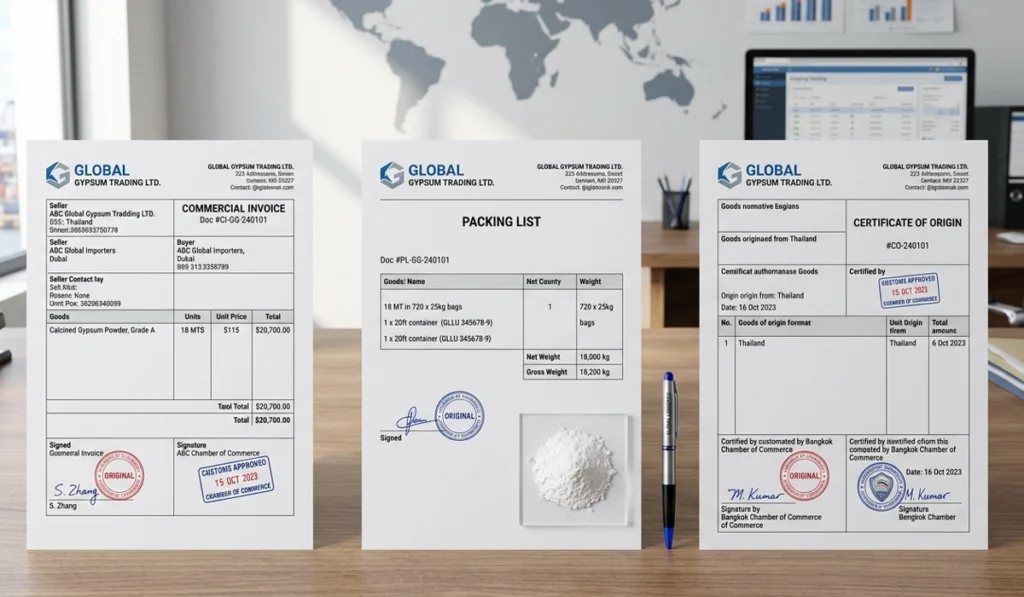
The commercial invoice and packing list look routine, and they cause more delays than any exotic certificate.
Under a letter of credit, banks examine documents against the credit terms, and even small discrepancies can trigger refusal. The doctrine is documentary precision, not commercial reasonableness. An invoice describing “gypsum plaster powder” against a credit that says “calcined gypsum plaster” is a discrepancy, however obviously identical the goods are.
Agree the exact product description before the credit is issued, then use that wording on every document without variation.
The packing list needs bag count, pallet count, and both net and gross weight. A packing list with net weight only is a common omission, and it stalls clearance while the numbers are reconciled.
Transport and origin documents
The bill of lading is the carrier’s document and the one most likely to arrive late. Decide early whether you are using original bills couriered to the buyer, or a telex release. Originals that arrive after the vessel are a classic cause of demurrage.
Certificate of origin requirements for gypsum import vary by destination. A certificate of origin for gypsum is normally issued by a chamber of commerce in the exporting country.
Origin matters for three reasons. It affects the gypsum import duty applied, it determines eligibility under preferential trade agreements, and some destination countries apply import restrictions by origin. Import duty on gypsum powder is set nationally, so this guide publishes no rates. Preferential origin and non-preferential origin are different concepts with different evidence requirements. Confirm the position for your own country with your customs broker and your bank.
Some destinations also require the certificate to be attested or legalised, often by an embassy or a designated body. Confirm the exact format before shipment, not at the port.
Quality and inspection documents
Do I need a certificate of conformity to import gypsum? It depends entirely on the destination, and Section 4 covers the programmes.
The certificate of analysis is a different document from the conformity certificate, and buyers routinely confuse them. A certificate of analysis reports what the material actually contains, batch by batch. A conformity document states that the product meets a destination country’s regulatory requirements. One is a quality record; the other is a regulatory permission.
A pre-shipment inspection certificate sits alongside both. Where a conformity programme applies, an accredited body such as SGS, Intertek or Bureau Veritas inspects and tests before the goods leave the exporting country.
For what the analysis document should contain and how to read it, see how to read the certificate of analysis.
Conformity Programmes at Destination
Gypsum import requirements do not stop at classification and paperwork. Several countries operate mandatory pre-export conformity programmes. Goods arriving without the required certificate can be refused entry, re-exported or heavily delayed.
The programmes vary by name and by structure. Kenya operates Pre-Export Verification of Conformity (PVoC) through the Kenya Bureau of Standards. Saudi Arabia operates SABER, the electronic platform for SASO conformity certificates. Nigeria operates SONCAP through the Standards Organisation of Nigeria. Several other markets in the Gulf and East Africa run comparable schemes.
Two cautions matter more than the list itself.
First, these programmes apply to regulated products, and each country publishes its own scope. Whether gypsum or a gypsum-based preparation falls inside that scope is a country-by-country question. Do not assume it does, and do not assume it does not.
Second, these schemes are renamed and restructured more often than any other requirement in this guide. A programme name from a two-year-old article may no longer be current.
So treat this section as a prompt, not an answer. Confirm the destination’s current requirements at the quotation stage, through the national standards body or an accredited inspection body. That is a five-minute question before shipment and a very expensive one after arrival. Where a programme does apply, build its lead time into the production schedule, because inspection happens before the goods leave.
Getting a Binding Ruling Before You Ship
How to get a binding tariff ruling for gypsum is the most useful question in this guide, and the answer is genuinely straightforward.
Most major customs administrations issue advance classification decisions on request. In the EU this is Binding Tariff Information (BTI). A BTI is a legal decision issued by a member state’s customs authority. It is provided free of charge, is generally valid for three years, and binds both the holder and every customs administration across the EU. The rules sit in Articles 22 to 37 of the Union Customs Code, and issued decisions are published in the public EBTI database.
The United States runs an equivalent system. US Customs and Border Protection issues advance rulings that represent CBP’s official position and are legally binding on CBP until modified or revoked. They carry no expiry date, are issued free of charge, and are published in the searchable CROSS database.
The practical difference between a binding ruling and a supplier’s opinion is simple. One is enforceable against the authority; the other is not.
Apply before the first shipment, not after a dispute. Give a full description, the composition, and samples or images if you can. For a product sitting near the 2520 / 3214 boundary, this is the single highest-value hour an importer can spend.
Where Shipments Get Held
Why was my gypsum shipment held at customs? Almost always for one of the reasons below. Each has a root cause and a decision that would have prevented it.
| Failure | Root cause | The decision that prevents it |
| Shipment reclassified, back-duty charged | Additive-rich product declared under the plaster heading | Obtain a binding ruling before the first shipment |
| Bank refuses the documents | Invoice description does not match the LC wording | Agree the exact product description before the LC is issued |
| Goods held for a missing conformity certificate | Destination operates a mandatory programme the buyer did not know about | Confirm the destination’s conformity requirements at the quotation stage |
| Demurrage charges accumulate | Original bill of lading arrived after the vessel | Agree telex release or courier timing in the contract |
| Certificate of origin rejected | Attestation or legalisation not obtained | Confirm the exact origin-document format required at destination |
| Duty assessed higher than budgeted | Wrong national code assumed from a six-digit heading | Confirm the full national code with a broker before ordering |
| Weight dispute at discharge | No independent weight certificate | Specify who appoints the surveyor and who pays |
| Repeat delays on every shipment | The first classification was never formalised | Register the ruling and reuse it |
Two patterns are worth drawing out.
The first is that most of these failures cost money through time, not through penalties. Demurrage runs while everyone waits for one missing signature. The charge has nothing to do with the goods and everything to do with the paperwork.
The second is that the same failure repeats. A first-time importer who declares a filler powder under the plaster heading may clear the first three shipments without comment, then meet a reclassification months later covering all of them. Early clearance is not evidence that a classification is correct; it often just means nobody has looked yet. Formalising the classification once ends that exposure permanently.
The documentary failures share a pattern too. A bank refusing documents under a letter of credit is not judging the goods, only the papers against the credit terms. An invoice description that varies by two words from the agreed wording is enough. So is a packing list showing net weight where the credit calls for gross.
Origin documents fail for a different reason: format rather than content. A correctly issued certificate of origin can still be rejected because the destination required attestation or legalisation that nobody arranged. That requirement is knowable in advance and almost never discovered in advance.
Weight disputes at discharge are the quietest of these failures, and the hardest to resolve after the fact. Where payment follows weight, agree who appoints the independent surveyor and who pays for the survey before the vessel sails.
A producer’s own document set also tends to clear faster than a trader’s re-issued paperwork. The mill documentation, the analysis and the invoice all originate from one entity, so they agree with each other.
What to Ask Your Supplier For
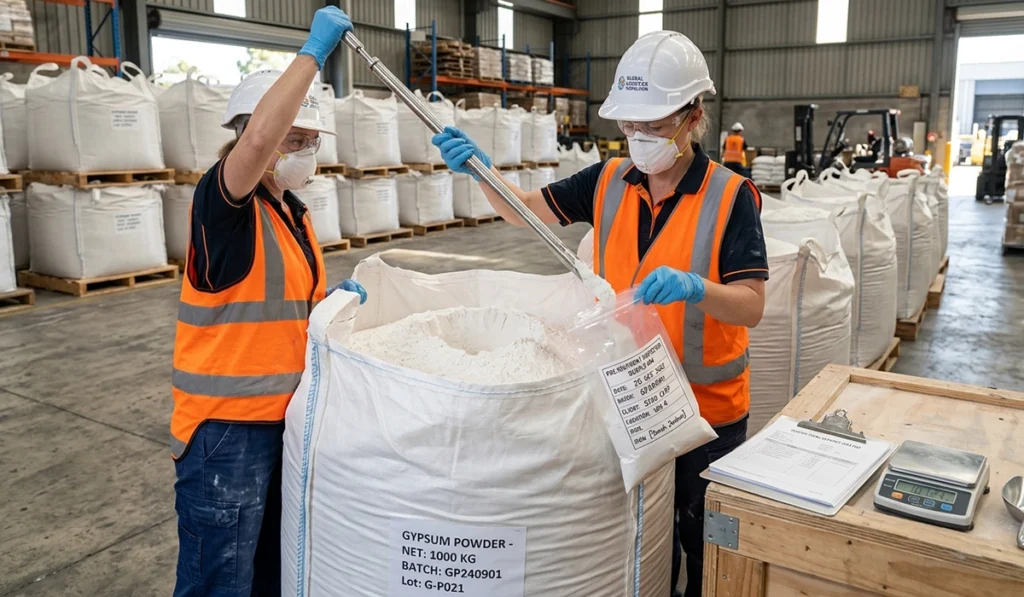
Ask your supplier for a full composition breakdown and a technical data sheet before you classify anything. That is exactly what a customs authority will ask you for if it questions the declared code.
Composition is the evidence that settles the 2520 versus 3214 question. Without it, neither you nor your broker can argue the point, and a binding ruling application will be returned incomplete.
Then ask for four things at quotation stage, not after the order:
- The full set of gypsum export documents issued as standard, and which cost extra
- Whether third-party inspection through SGS, Intertek or Bureau Veritas can be arranged
- Whether the supplier is the producer or a trader re-issuing documents
- The exact product description they will put on the invoice, so it can be written into the LC
A direct producer can supply composition breakdowns and mill documentation rather than re-issued trader paperwork. Rezvan Mines works with routine third-party inspection through SGS and Intertek, and can supply the supporting documentation on request.
Confirming the gypsum HS code for your destination remains your decision and your broker’s. The supplier’s job is to give you the evidence to make it. See the full product range with specifications, or request the full document set.
Conclusion
Gypsum classification is simpler than it looks for raw stone and calcined plaster, and genuinely contested for additive-rich powders. Heading 2520 splits at calcination: 2520.10 for gypsum and anhydrite, 2520.20 for plasters carrying only small quantities of accelerators or retarders. Once the additive content becomes meaningful, heading 3214 enters the picture and the answer stops being obvious.
Two decisions follow. First, get a binding ruling before the first shipment rather than after a reassessment. It is free in the EU and the US. It is also the only answer that binds the authority clearing your goods. Second, settle the exact invoice wording, the origin-document format and the destination’s conformity requirements at quotation stage. Each is cheap to fix before shipment and expensive afterwards.
Request the full document set and take it to your broker before you order.
FAQ
What is the HS code for gypsum powder?
Most gypsum powders fall under heading 2520. Uncalcined gypsum and anhydrite sit at 2520.10; calcined plasters sit at 2520.20. The first six digits are international, but your destination’s full code will be longer. Confirm it locally.
Is raw gypsum a different code from gypsum plaster?
Yes. The split is calcination, not particle size. Raw or ground uncalcined stone is 2520.10. Plaster made by calcining gypsum is 2520.20, provided additives stay within the heading’s “small quantities of accelerators or retarders” wording.
Which code applies to putty powder and joint filler?
That depends on composition and intended use, and it is a genuine dispute area. Additive-rich surfacing preparations may fall under heading 3214 rather than 2520. Obtain a binding ruling with a full composition breakdown before shipping.
What documents does an importer need?
Typically a commercial invoice, packing list, bill of lading and certificate of origin. Add a certificate of analysis, weight certificate, insurance certificate, safety data sheet or conformity certificate depending on destination, payment terms and the agreed Incoterm.
Do I need a certificate of conformity?
Only if the destination operates a mandatory conformity programme covering your product. Kenya, Saudi Arabia and Nigeria run such schemes, among others. Scope varies by country and changes often, so confirm before shipment.
Why do shipments get held at customs?
Most often a documentary mismatch, a missing conformity certificate, or a classification the authority disputes. Bills of lading arriving after the vessel are another frequent cause, and demurrage accumulates while the paperwork is resolved.
Is gypsum classed as dangerous goods for shipping?
Producer safety data sheets generally show gypsum as not regulated for transport under IMDG, IATA or road rules. A safety data sheet is still commonly requested, and dust-exposure information on it remains relevant for handling.
How long is a binding ruling valid?
In the EU, a Binding Tariff Information decision is generally valid for three years and binds all EU customs administrations. US CBP advance rulings carry no expiry date and remain binding on CBP until they are modified or revoked.